
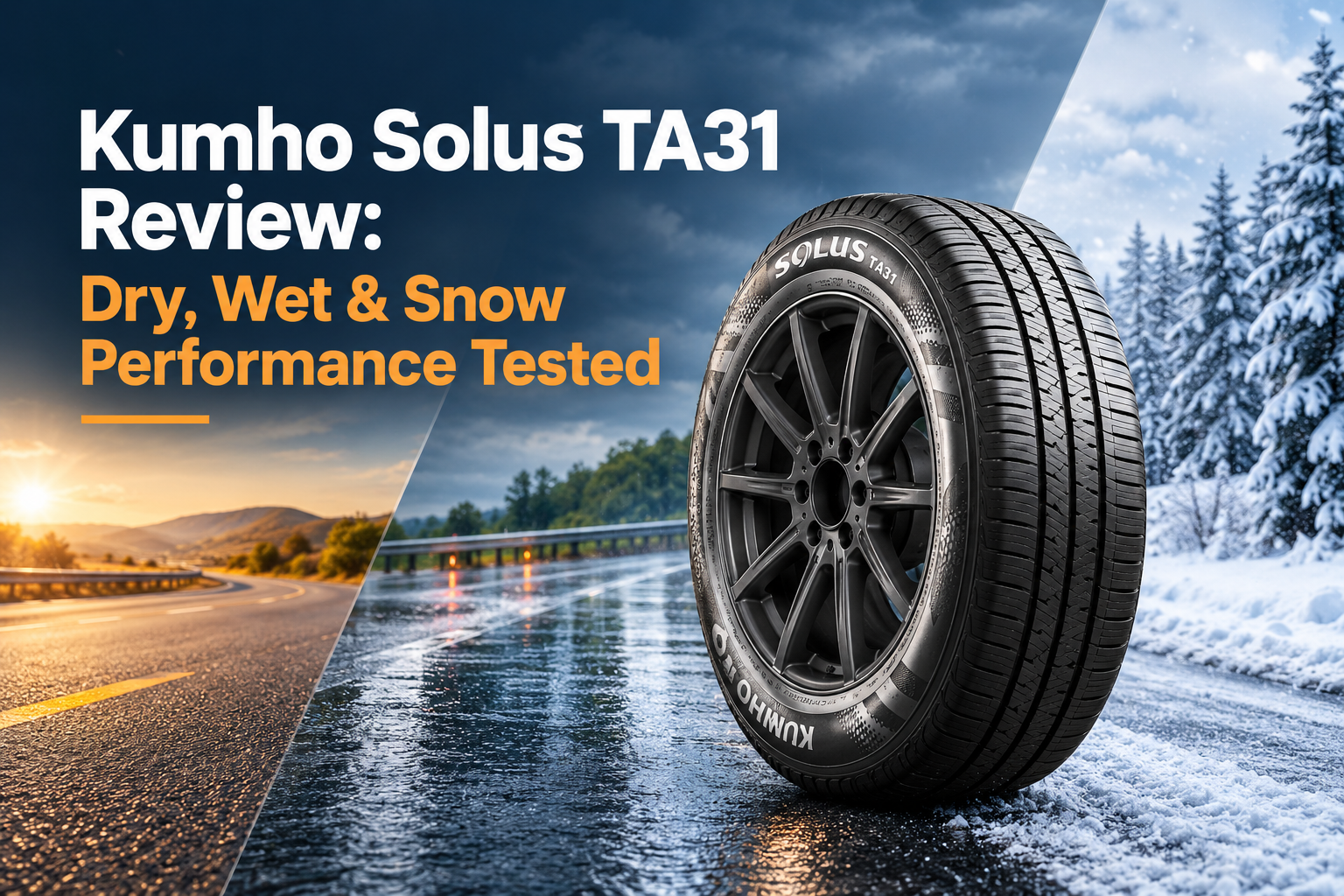
Quick Verdict
The Kumho Solus TA31 is a comfortable, wallet-friendly all-season touring tire built for sedans, minivans, and crossovers. It rides quietly, handles wet roads with real confidence, and comes with a genuine 60,000-mile treadwear warranty. Its biggest weakness is winter grip, it isn't 3PMSF-certified, so it struggles once snow gets deep or the road ices over.
Good for budget-conscious daily drivers in mild climates and owners simply replacing worn factory tires with the same set.
Advantages
- Quiet, comfortable ride that holds up over time
- Strong wet grip and excellent hydroplane resistance
- Genuine 60,000-mile treadwear warranty
- Affordable price for what you get
- Low rolling resistance that supports better fuel economy
Disadvantages
- Weak snow and ice traction, no 3PMSF certification
- Uneven front wear on FWD cars without regular rotation
- Limited cornering grip in aggressive or emergency handling
- Ranks below several similarly priced competitors overall
- Limited grip in hard, aggressive cornering
-
Dry Performance
-
Wet Performance
-
Snow & Ice
-
Ride Comfort & Noise
-
Tread Life
-
Fuel Efficiency
-
Value for Money
Kumho didn’t have to try hard to get this tire onto millions of cars. The Solus TA31 rolled out of the factory on the Hyundai Sonata, Kia Soul, Kia Seltos, Kia Forte, Chevrolet Spark, and even the Chrysler Pacifica minivan. When it came time to replace their worn-out originals, most owners just bought the same tire again. No research, no second-guessing.
That’s exactly why this Kumho Solus TA31 review exists. Familiarity isn’t the same thing as quality, and a lot of drivers want to know if this tire actually earns its spot on their car or if it’s just the tire that happened to already be there. We pulled together owner reports, forum threads, and lab-style test data to give you the real picture, good and bad.

What Kind of Tire Is the Kumho Solus TA31?
The Solus TA31 is a grand touring all-season tire. That means it’s built for sedans, minivans, and crossovers, not sports cars. Its job is simple: give you a quiet ride, decent grip in rain, and enough tread life to make the price tag worth it.
Here’s the spec sheet at a glance.
| Spec | Details |
|---|---|
| Tire Type | Grand Touring All-Season |
| Season Rating | All-Season (M+S rated; no 3PMSF snowflake symbol) |
| UTQG Rating | 600 AA A (Treadwear 600, Traction AA, Temperature A) |
| Speed Rating | H and V, depending on size |
| Rim Sizes | 14 to 18 inches |
| Popular Sizes | 195/65R15, 205/60R16, 215/55R17, 225/55R17, 225/60R17 |
| Tread Warranty | 6 years / 60,000 miles (not valid on OE fitments) |
| Road Hazard Warranty | 1 year, or first 2/32″ of wear |
| Construction | Twin steel belts, spiral-wrapped nylon cap, polyester cord ply |
| Price Range | Roughly $65 to $130 per tire |
| Common OE Fitments | Hyundai Sonata, Kia Soul, Kia Seltos, Kia Forte, Chevrolet Spark, Chrysler Pacifica |
One thing to flag before you buy: if you run different sizes front and rear, your mileage warranty gets cut in half. And if these tires came on your car from the factory, Kumho won’t honor the mileage warranty at all.
What Makes the Kumho Solus TA31 Different
Every tire brand claims its tread pattern is “engineered.” So what’s actually going on under the rubber here, and does it change how the tire drives?
The TA31 uses a symmetric tread pattern built around a continuous center rib. That rib runs straight down the middle of the tire, and it’s the reason the steering feels so settled on the highway. There’s no wandering, no correcting. You point the car, and it goes.
Around that rib sit four circumferential grooves. Their job is to grab water and push it out from under the tire before it can build up. This is the main reason wet grip turns out better than you’d expect from a budget tire.
Inside the tire, two steel belts sit under a spiral-wrapped nylon cap, with a polyester cord ply underneath that. This combination does double duty. It keeps the tire stable at higher speeds, and it also soaks up small road imperfections instead of transmitting them into the cabin. That’s the engineering behind the smooth, quiet ride owners keep mentioning.
The sipes cut into the tread blocks add extra biting edges. In light rain or slush, those edges help the tire find grip that a plain rubber block couldn’t. They won’t turn this into a snow tire, but they do stop it from being useless in a light drizzle.
None of this is exotic technology. It’s a straightforward, well-executed setup aimed at comfort and everyday traction, not aggressive performance. Keep that in mind as you read the breakdown below, because it explains almost everything about how this tire behaves.
Kumho Solus TA31 Review: Performance Breakdown
This is the part that actually matters. Here’s how the tire performs, category by category, based on real driver reports and independent testing.
Dry Performance
On dry pavement, the TA31 feels composed. Braking is predictable, and the steering stays accurate at highway speed. One reviewer who pushed a Nissan Maxima hard on dry roads reported no surprises, no sudden loss of grip.
Push it into a hard corner, though, and the limits show up quickly. This is a touring tire, not a performance tire, so that trade-off is expected rather than a flaw.
Wet Performance
Wet grip is where this tire quietly impresses. The grooves clear water fast, and hydroplane resistance rates as excellent in most independent tests. Owners describe confident handling in rain, with braking that lands at average to slightly above average for the class.
One caveat worth knowing: a Chrysler Pacifica owner reported the wet grip fading noticeably as the tread wore down. Fresh tread matters a lot here, more than it does with some competitors.
Snow and Ice Performance
This is the weak spot, and it’s worth being blunt about it. The TA31 carries an M+S rating but does not carry the Three-Peak Mountain Snowflake certification. That symbol matters, because it means the tire wasn’t built or tested for real winter conditions.
In light snow, the sipes offer some help. But owners in snowier climates describe it as barely better than a summer tire once the snow gets deep. One Hyundai forum user put it plainly: no better than a Prius tire in the snow. On ice, independent data puts its grip score around 20%, which is low. If you get real winters, plan on a dedicated winter tire and don’t lean on this one.
Ride Comfort and Noise
This is the tire’s best category, full stop. The dual-layer construction absorbs bumps and rough pavement well, and road noise stays low across most surfaces. A Toyota Camry owner who put 60,000 kilometers on a set said the comfort held steady the entire time, with no noticeable drop-off as the tread wore down.
If a quiet, relaxed ride is your priority, this tire delivers more than its price would suggest.
Tread Life
Results here are mixed, and your driving style plays a big role. The 60,000-mile warranty and 600 treadwear rating point to good longevity, and some owners hit that mark. A Chevrolet Cruze owner reported 35,000 miles of spirited driving with tread to spare.
But front-wheel-drive vehicles wear these tires unevenly if you skip rotations. One Holden Cruze owner saw excessive front wear after just 5,000 miles. The fix is simple: rotate every 5,000 to 6,000 miles, no exceptions, especially on a front-wheel-drive car.
Fuel Efficiency
The tread pattern is designed to cut rolling resistance, and it seems to work. A Kia Seltos owner reported fuel economy that beat the car’s rated figures, crediting the tires. Don’t expect Michelin Primacy or Bridgestone Ecopia-level savings, but this tire won’t hurt your mileage the way some cheap tires do.
Value for Money
At $65 to $130 per tire, this sits in budget-to-mid-range territory. For that price, a quiet ride, decent wet grip, and a genuine 60,000-mile warranty add up to real value.
The catch is that similarly priced competitors score higher in independent rankings. One comparison from Hyundai owners had the TA31 ranked 36th out of 54 tires in its class on Tire Rack. That’s not disqualifying, but it’s a number worth knowing before you commit.
Who Should Actually Buy This Tire
The budget-conscious daily driver. If you drive a sedan or small crossover in a mild climate and just want a quiet, comfortable ride without spending a lot, this tire earns its price.
The OE replacement shopper. If your car came with these tires from the factory and you had no complaints, buying the same set again is a low-risk, sensible choice.
The mild-winter driver. If your winters mean light rain and the occasional frost, not real snow, this tire covers you year-round without needing a dedicated winter set.
If you drive somewhere with heavy snow, want the longest possible tread life, or push your car hard through corners, keep reading, because the alternatives below might fit you better.
Cross-shopping within Kumho’s own lineup? Our Kumho Solus TA51A review breaks down how that tire compares on comfort, wear, and price.
Alternatives to the Kumho Solus TA31
No tire wins every category, so here’s how three real competitors stack up against it, and who should actually pick each one.
General Altimax RT43 (~$75 to $120 per tire)
This is the closest direct competitor, and it beats the TA31 in two places that matter: tread warranty (75,000 miles versus 60,000) and snow traction. Forum users consistently rank it above the Kumho across most categories. It’s a bit noisier on some surfaces, but if tread life and light winter capability matter more to you than pure quiet, the RT43 is the better buy.
Hankook Kinergy PT (~$70 to $125 per tire)
Comfort is a wash between these two, but the Kinergy PT edges ahead in wet traction and wears more consistently over time. It’s priced almost identically to the TA31, so this comes down to a straight size and availability check before you decide. If both are available in your size at a similar price, the Kinergy PT is the slightly safer pick.
Michelin CrossClimate 2 (~$140 to $200 per tire)
This is the tire to get if budget isn’t the deciding factor. It carries the 3PMSF winter certification the TA31 lacks, and it outperforms it in wet grip and tread life too. It costs roughly double, so it only makes sense if you drive in real winter conditions or simply want the best all-season tire you can buy. TyreReviews rates it as the top all-season option for good reason.
Kumho Solus TA31 Review: Final Verdict
The Kumho Solus TA31 is a solid, no-drama tire for drivers who want comfort and a fair price more than they want class-leading performance. It rides quietly, handles wet roads with real confidence, and comes backed by a warranty that actually means something at this price point.
It’s not the tire for you if you deal with real winters, want the longest tread life on the market, or drive aggressively through corners. Rotate it on schedule, keep your expectations realistic in the snow, and it’ll do exactly what a budget touring tire should do: get you through the year without any drama.
Buy it if: you want a quiet, affordable all-season replacement for mild-weather driving. Skip it if: you face real winters, drive hard, or want the longest tread life available.
Frequently Asked Questions
Is the Kumho Solus TA31 a good tire? For everyday driving in mild conditions, yes. It’s quiet, handles wet roads well, and comes with a genuine 60,000-mile warranty at a fair price. It ranks below some class leaders in overall performance and winter traction, so it’s a solid, honest tire rather than a class winner.
How many miles does the Kumho Solus TA31 last? Kumho backs it for 60,000 miles. Real-world results vary a lot. Rear-wheel and all-wheel-drive cars with regular rotations tend to get closer to that number. Front-wheel-drive cars wear faster, especially without rotations every 5,000 to 6,000 miles.
Is the Kumho Solus TA31 good in snow? Only in light snow. It carries an M+S rating but not the Three-Peak Mountain Snowflake certification, so it isn’t built or tested for serious winter driving. In areas with heavy snow or ice, a dedicated winter tire is the safer call.
What vehicles use the Kumho Solus TA31 as original equipment? It ships as factory equipment on the Hyundai Sonata, Kia Soul, Kia Seltos, Kia Forte, Chevrolet Spark, and Chrysler Pacifica, among others, mostly through Kumho’s strong relationship with Hyundai Motor Group.
How does the Kumho Solus TA31 compare to the Michelin CrossClimate 2? The CrossClimate 2 wins in almost every category, especially winter traction, wet grip, and tread life, but it costs close to double. If you’re in a mild climate and watching your budget, the TA31 remains a reasonable, honest alternative.