
Quick Verdict
The closest thing to a "set it and forget it" all-season tire for trucks and SUVs. Best for light truck, SUV and CUV owners who do 90% or more of their driving on paved roads.
The Good
- Outstanding tread life with a 75,000-mile warranty backed by real-world results
- Excellent wet traction and hydroplaning resistance for a truck-sized tire
- Strong all-season snow capability with a genuine 3PMSF certification
- Composed, smooth highway ride that makes heavy trucks feel settled
- Broad size range covering 15 to 20-inch fitments for most trucks and SUVs
- 6-year coverage period is among the best warranty terms in its class
The Bad
- Premium price. A full set can cost well over $800 before installation
- Slightly noisier than the outgoing Defender LTX M/S on smooth pavement
- Not suited for serious off-road use. Highway-focused tread only
- Dry stopping distance is not class-leading. The Continental TerrainContact H/T edges it out
- Higher price amplifies the sting if a tire is damaged early without road hazard coverage
- Cost-per-mile advantage only materializes for higher-mileage drivers
-
Dry Performance9.6
-
Wet Performance9.2
-
Snow and Ice8.5
-
Ride Comfort and Noise9.2
-
Tread Life9.3
-
Fuel Efficiency8.5
-
Value for Money8.5
If you own a pickup truck or a full-size SUV and you are shopping for a new set of tires, the Michelin Defender LTX M/S2 is almost certainly on your shortlist. And for good reason, this tire has become one of the most talked-about options in the highway all-season segment since it launched in the United States in October 2023.
The short version? It is one of the best all-season tires you can put on a light truck or SUV right now. It rides quietly, grips confidently in the rain, handles light snow better than most owners expect and delivers serious tread life that justifies the price over the long run.
But it is expensive. You are paying a full Michelin premium here. This review will give you a clear, honest picture of what you are getting. What the real-world trade-offs are and whether this tire makes sense for your specific situation.
Michelin Defender LTX M/S2: Key Specs at a Glance
| Specification | Detail |
|---|---|
| Tire Type | Highway All-Season (On-Road) |
| Season Rating | All-Season · M+S Rated |
| Vehicle Fitment | Light Trucks, Full-Size SUVs, CUVs, Vans |
| Compatible Models | F-150, Tundra, Ram 1500, Silverado, Tahoe, Expedition, Suburban, 4Runner, Durango |
| UTQG Rating | 820 B A (Treadwear 820 / Traction B / Temp A) |
| Tread Warranty | 70,000 miles (T & H speed-rated) · 50,000 miles (LT-metric / S-rated) |
| Size Range | 255/70R16 up to 285/45R22 (100+ sizes) |
| Price Per Tire | ~$185 (16–17″) · ~$220–$280 (18–20″) · ~$300–$360 (20–22″) |
| Key Technologies | EverTread 2.0 Compound, SipeLock Technology, MaxTouch 2.0, Piano Acoustic Tuning |
| Tread Depth | 11/32″ – 14/32″ (size dependent) |
| Speed Rating | S (112 mph) / T (118 mph) / H (130 mph) |
| Generation | M/S2 – launched October 2023, successor to original Defender LTX M/S |
What Is the Michelin Defender LTX M/S2?
The Defender LTX M/S2 is the direct successor to Michelin’s highly regarded Defender LTX M/S, which was already one of the top-rated all-season truck tires on the market. Michelin updated virtually everything under the hood for the M/S2 version.
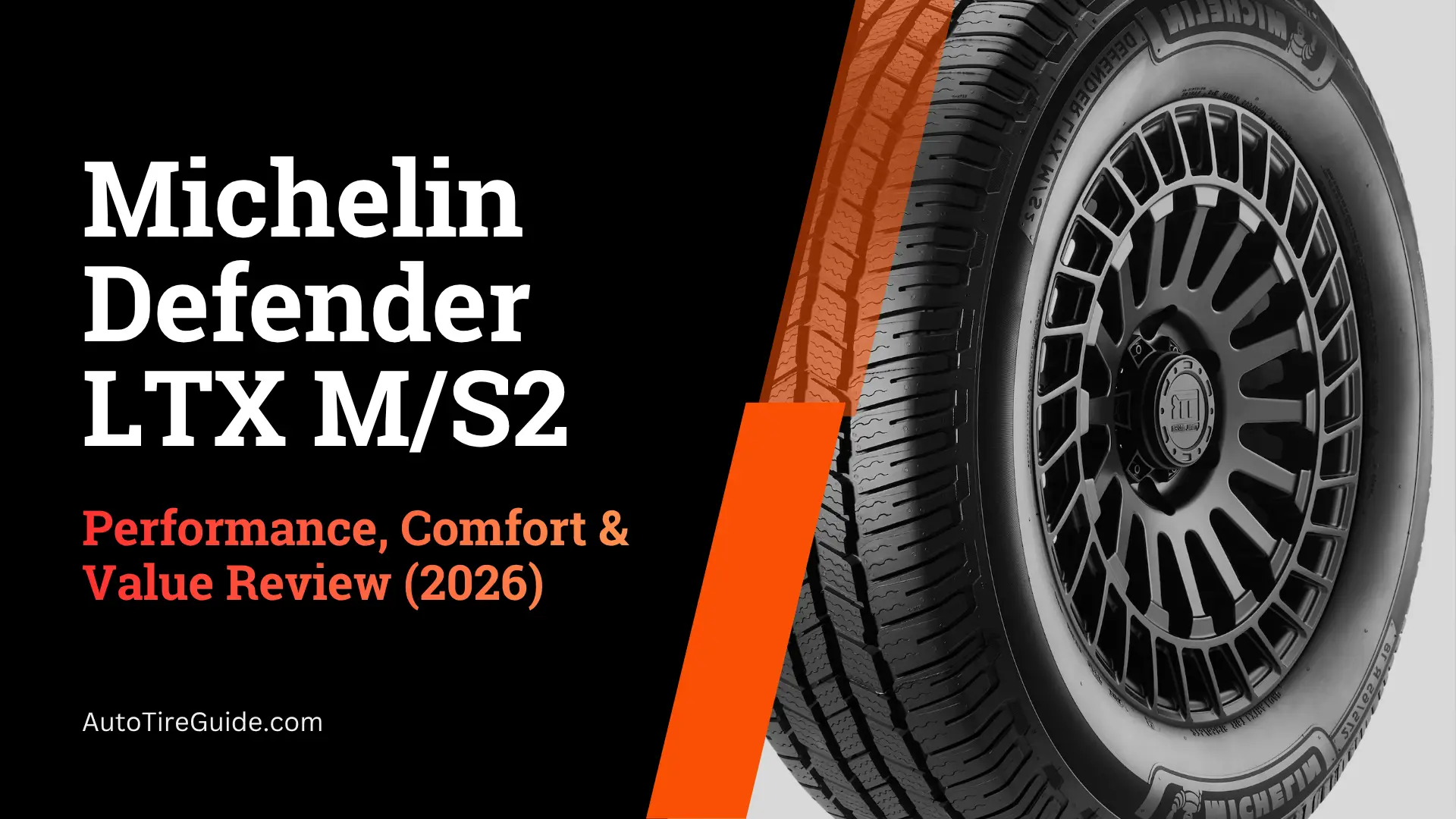
The biggest upgrade is the EverTread Compound 2.0, a more durable rubber formula designed to resist wear on rough and varied road surfaces. Michelin pairs this with advanced 3D SipeLock technology, a system where the sipes interlock when the tire is loaded to maintain tread stiffness in corners and braking situations, while still opening up under lower loads to bite into wet or snowy surfaces.
The tread design is symmetrical with four wide circumferential grooves, open shoulder blocks and high-density sipes on every tread rib and shoulder block. Twin steel belts and a polyamide reinforcement layer handle the structural work underneath, providing load capacity and stability at highway speeds.
In treadwear testing, Michelin claims the M/S2 provided an estimated 95,200 miles of tread life in size 275/55R20 on 2020 Ford F-150s, compared to 65,900 miles for the Continental TerrainContact H/T and 45,300 miles for the Bridgestone Alenza AS Ultra in the same test.
Tire Technology and Construction
The Michelin Defender LTX M/S2 is not just a restyled version of its predecessor. Michelin reworked the compound, the internal structure and the sipe design from the ground up. Understanding what is inside this tire explains why it performs the way it does.
EverTread Compound 2.0
This is the most significant upgrade over the original Defender LTX M/S. The EverTread Compound 2.0 is a proprietary rubber blend formulated to resist heat buildup and surface degradation over long distances.
The compound stays more consistent in its grip characteristics as the tire ages, which is why M/S2 owners frequently report that wet traction holds up well even at lower tread depths. Most tires lose wet grip noticeably as they wear. This one holds on longer.
3D SipeLock Technology
Sipes are the small cuts in the tread blocks that create biting edges for snow and wet traction. On most tires, sipes can flex and collapse under cornering loads which reduces stability.
Michelin’s 3D SipeLock design uses interlocking three-dimensional sipe walls. When the tire is under load in a corner or during hard braking, the sipe walls lock together and act as a rigid block. When the load releases, the sipes open back up to grip wet or snowy surfaces. You get handling stability and traction at the same time which is a genuine engineering achievement for this class of tire.
Internal Construction
The internal structure consists of two high-tensile steel belts for durability and load support. A polyamide reinforcement layer sits on top of the belts which helps maintain the tire’s shape at highway speeds and under heavy loads like towing or carrying a full truck bed.
A single-ply polyester cord body forms the carcass. This keeps the tire lighter than a heavier multi-ply construction while still delivering the sidewall strength needed for truck and SUV loads.
Tread Design
The tread pattern is symmetrical with four wide circumferential grooves running the full length of the tire. These grooves are the primary water evacuation channels and are key to the tire’s hydroplaning resistance.
Open shoulder blocks with lateral grooves improve cornering bite on wet and snowy surfaces. High-density sipes cover every tread rib and shoulder block adding thousands of extra biting edges across the contact patch.
The outer shoulder blocks are more rigid compared to the original M/S. This increases cornering stability on dry pavement. The trade-off is a marginal increase in road noise on smooth surfacesbwhich is the most common complaint from owners who drove the previous version.
Michelin Defender LTX M/S2 Performance Breakdown
Dry Performance
On dry pavement, the Defender LTX M/S2 feels planted and confident. Steering response is clean and precise. Owners on truck forums consistently describe the handling as tight, with minimal squirm under hard cornering.
Michelin’s own testing showed roughly a 2% improvement in stopping distance and about a 4% gain in cornering grip over the older M/S. In independent group testing, the M/S2 led its test group in handling stability and steering responsiveness, which makes sense because this tire is engineered for loaded truck and towing scenarios, not empty parking lot heroics.
One honest caveat from test data in the same group test. The M/S2 stopped from 50 mph in approximately 140 feet on dry pavement, which placed it last among the tires tested. The Continental TerrainContact H/T managed around 130 feet. That is a real difference, though it is worth noting most owners will never approach those scenarios in daily driving.
Wet Performance
This is where the Michelin Defender LTX M/S2 earns its loudest praise from real owners. The four wide circumferential grooves and full-depth sipes do serious work evacuating water from under the tread.
In group testing, the M/S2 stopped from 50 mph in just 100 feet on wet pavement, ranking third behind the Continental (97 feet) and Bridgestone Dueler (99 feet) but comfortably ahead of several other competitors and well ahead of most original equipment tires.
Owner forums are full of similar reports. An F-150 owner who switched from Goodyear Wrangler Adventurer tires described the improvement as night and day. Hydroplaning resistance is genuinely impressive for a tire at this size and weight. Multiple owners have noted they can accelerate hard in the rain without wheel spin, which for a heavy truck is a meaningful real-world benefit.
Snow and Ice Performance
The Defender LTX M/S2 carries the 3 Peak Mountain Snowflake (3PMSF) rating, which means it has passed standardized testing for severe snow conditions. That is not a given for all-season tires.
In light snow, the tire performs well above average for its category. Owners who have driven it through proper winter storms consistently report being surprised at how capable it is. Deep snow is where the limitations become clearer. The symmetric tread pattern does a solid job but is not going to compete with a true all-terrain tire or a dedicated winter tire in serious accumulation.
Ice is the weakest point, as it is for nearly all all-season tires. A score of 7.9 out of 10 for ice traction is respectable for the category but if you live somewhere that deals with regularly iced roads, a set of dedicated winter tires remains the right call for those months.
Ride Comfort and Noise
Highway comfort is very good. The M/S2 absorbs road imperfections smoothly and at highway speeds the ride is notably composed for a truck tire. Multiple owners have described it as making their heavy trucks feel almost like passenger cars on the freeway.
Noise is a slight area of nuance. Several experienced owners who switched from the older Defender LTX M/S noted that the M/S2 generates slightly more road noise on paved surfaces. This comes up consistently enough in forum discussions that it is worth mentioning.
In the context of the full category, the noise level is still well above average. But if you are expecting the hushed near-silence some reviewers describe with the original M/S, manage your expectations slightly.
Tread Life
The tread life story is where the Defender LTX M/S2 really separates itself from the competition. The UTQG treadwear rating of 820 is very high, and real-world owner experiences back it up.
One Ford Expedition owner on BobIsTheOilGuy has run six consecutive sets of LTX M/S and LTX M/S2 tires across 400,000 miles on the same vehicle. Another regular contributor notes he typically runs his M/S2 tires to 6 or 7/32nds of remaining tread, which works out to 65,000 to 75,000 miles per set.
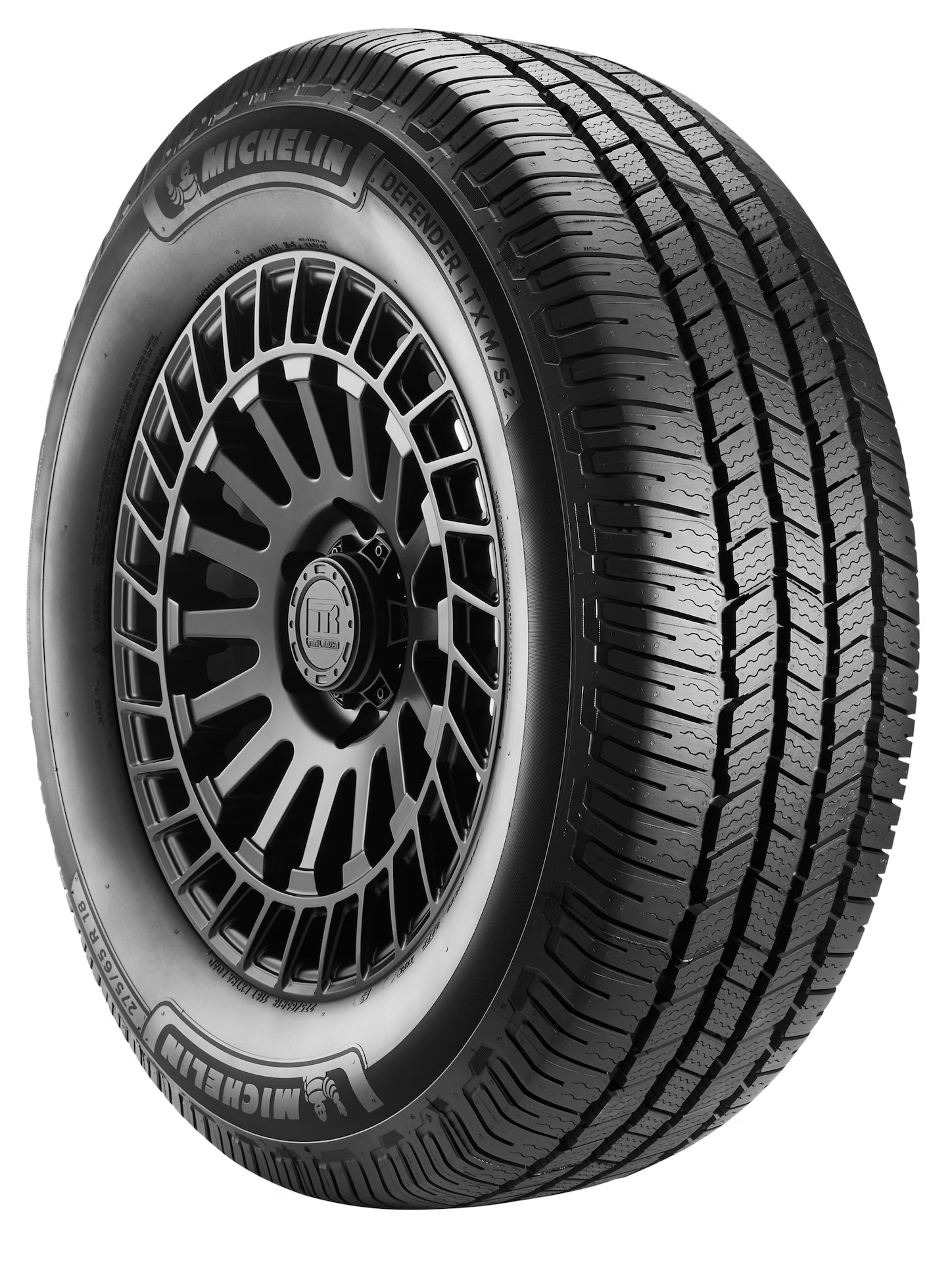
The 75,000-mile warranty with a 6-year coverage period is among the best you will find in this segment. Unlike some budget tires that technically reach their warranty mileage but lose wet traction well before that point. The M/S2 is reported to maintain strong wet performance even at lower tread depths.
Fuel Efficiency
All-season truck tires are not known for outstanding rolling resistance and the Defender LTX M/S2 is not an exception. However, Michelin has worked to optimize the EverTread Compound 2.0 for reduced rolling resistance compared to the previous generation.
Real-world owners do not typically notice a dramatic difference in fuel economy when switching from similar all-season truck tires but the tire does not hurt efficiency in a measurable way either. For a truck tire in this class, that is about the best outcome you can hope for.
Value for Money
At $170 to $280 per tire, the Defender LTX M/S2 is undeniably a premium purchase. A full set of four on a full-size truck can run well over $800 before installation.
The value case rests on tread life and peace of mind. If you are doing the cost-per-mile math and rotating properly, the M/S2 can actually come out close in cost to mid-tier competitors that need replacing sooner. Add in the 75,000-mile warranty and the strong wet performance and the case for spending more upfront becomes surprisingly solid.
That said, if you drive fewer than 10,000 miles per year, the tread life advantage takes longer to materialize, and a less expensive option may make more financial sense.
Who Should Buy the Michelin Defender LTX M/S2?
1. The High-Mileage Commuter with a Truck or SUV
If you put 15,000 to 20,000 miles per year on your F-150, Tundra or Silverado and want one tire that handles rain, occasional snow and highway miles without drama or frequent replacement, this tire was built for you. The cost-per-mile math works heavily in your favor.
2. The Family Road-Tripper
Long highway drives in a Tahoe, Expedition or Sequoia loaded with passengers and luggage demand a tire that stays quiet, stable and confident in variable weather. The M/S2 checks every one of those boxes. Multiple owners describe the sensation of a loaded vehicle becoming noticeably more composed and planted after fitting this tire.
3. The Light-Duty Tow Vehicle Owner
If you occasionally tow a boat, camper or trailer but spend most of your time on paved roads, the M/S2’s load ratings, sidewall reinforcement and handling stability under load make it a very capable choice. It is not an all-terrain tire, but it handles the occasional gravel boat ramp or unpaved campground entry without complaint.
Alternatives to the Michelin Defender LTX M/S2
1. Continental TerrainContact H/T (~$140 to $200 per tire)
The TerrainContact H/T is the most frequently mentioned competitor in forum discussions. It delivers dry stopping distances slightly better than the M/S2, earns top marks from Consumer Reports and typically comes in $20 to $40 per tire cheaper. Tread life is excellent, though most testing and owner data suggests it falls somewhat short of the M/S2’s longevity. If budget is a meaningful concern and you want a tire with a stronger dry braking edge, the Continental deserves serious consideration.
2. Pirelli Scorpion All Season Plus 3 (~$150 to $210 per tire)
A strong option for SUV and crossover owners who want a quieter tire with excellent wet grip and a respectable tread warranty of 70,000 miles. Forum owners consistently praise its low noise levels, which edge out even the M/S2 on smooth pavement. The trade-off is slightly less aggressive snow capability and a treadwear rating that falls below the Michelin.
3. Firestone Destination LE3 (~$100 to $150 per tire)
If the Michelin’s price is simply outside your budget, the Destination LE3 is probably the most honest budget alternative in this category. It delivers solid all-around performance, earns good owner reviews for wet traction and costs meaningfully less. The trade-offs are a lower treadwear rating, somewhat less composed highway ride and less confident snow traction. For moderate mileage drivers who want a capable all-season without the premium spend, it is a legitimate choice.
Michelin Defender LTX M/S2: Final Rating and Verdict
The Michelin Defender LTX M/S2 is, without serious competition, one of the best all-season highway tires available for light trucks and SUVs in 2026. It does not try to be an all-terrain tire, and it does not pretend to replace a dedicated winter tire. What it does, including quiet highway miles, confident wet grip, genuinely impressive tread life, and a ride quality that makes heavy trucks feel settled and controlled, it does better than almost everything else in its segment.
The premium price is real. But when you do the cost-per-mile math against budget alternatives and factor in the tread life warranty, the case for spending more upfront is strong for anyone driving over 15,000 miles a year.
Buy it if: you need a quiet, long-lasting tire for mostly paved roads and variable weather. Look elsewhere if: you need serious off-road capability, drive very few miles per year, or are working with a tight budget.
Frequently Asked Questions: Michelin Defender LTX M/S2
How long does the Michelin Defender LTX M/S2 last?
Michelin backs it with a 75,000-mile, 6-year warranty, which is among the best in its class. Real-world owners with proper rotation schedules frequently report reaching 70,000 to 80,000 miles before replacement. Treadwear data from formal testing suggests the M/S2 can significantly outlast competing tires in its category.
Is the Michelin Defender LTX M/S2 good in snow?
Yes, better than most all-season truck tires. It carries the 3 Peak Mountain Snowflake rating for severe snow service. Owners in moderate winter climates consistently report confident traction in light to moderate snow. For serious winter conditions with frequent ice and deep snow, dedicated winter tires remain the safer choice.
What is the difference between the Michelin Defender LTX M/S and the M/S2?
The M/S2 introduced the updated EverTread Compound 2.0 for improved durability and longevity, along with refined 3D SipeLock sipes for better wet and snow traction. It also features more robust outer shoulder blocks for improved cornering stability. Most owners consider the overall upgrade meaningful, though some note the M/S2 generates slightly more road noise than the original M/S.
Is the Michelin Defender LTX M/S2 worth the price?
For high-mileage drivers and anyone who values long-term reliability and wet weather safety, yes. The cost-per-mile calculation over a full set’s lifetime often brings the Michelin close in total cost to cheaper alternatives that need replacing sooner. For low-mileage drivers, the value calculation is less clear-cut, and a less expensive alternative may make better financial sense.
What vehicles does the Michelin Defender LTX M/S2 fit?
It is designed for light trucks, SUVs, crossovers, and minivans. Common fitments include the Ford F-150, Chevrolet Silverado, GMC Sierra, Toyota Tundra, Chevrolet Tahoe, Ford Expedition, Toyota 4Runner, Honda Pilot, Jeep Grand Cherokee, and Cadillac Escalade, among many others. Sizes range from 15 to 20-inch diameters covering both P-metric and LT sizing.
2 Comments
I just installed a set on my RAM just a few days ago I read your take on the Michelin defender MS 2 and just noticed that the traction & temp you listed is reversed traction should be a B & temp should be A Thanks for your information enjoyed your review on this tire. Take care!!!!
Thank you for catching that! You are absolutely right; I went back and verified that it is Traction B and Temperature A. I have updated the article. Really appreciate you taking the time to help keep things accurate here. Enjoy those new tires on your RAM and take care!