
Quick Verdict
The Bridgestone Ecopia EP422 Plus is a touring all-season tire built around one goal: saving fuel without wrecking the ride. On that goal, it genuinely delivers, backed by Consumer Reports' own lab data, not just Bridgestone's marketing. Where it asks you to compromise is wet braking, real winter weather, and tread life that doesn't always match the number on the warranty.
Good for: highway commuters, EV and hybrid owners, and mild-climate drivers who want lower fuel bills more than they want class-leading grip.
Advantages
- Class-leading fuel efficiency, rated 5 out of 5 by Consumer Reports for rolling resistance
- One of the quietest touring tires available, also a 5 out of 5 Consumer Reports score
- Confident, predictable dry-road handling that beats expectations for an eco-focused tire
- Priced below premium rivals like the Michelin Defender T+H
- Strong hydroplaning resistance and decent lateral grip in the wet
Disadvantages
- Wet braking and acceleration trail class leaders like the Michelin Defender T+H
- No 3PMSF certification, and real-world snow traction is inconsistent
- Tread life regularly falls short of the 70,000-mile warranty without diligent rotation
- Ride comfort is only average, even though the cabin stays quiet
- Some owners report early or uneven wear, especially on front-wheel-drive vehicles
-
Dry Performance
-
Wet Performance
-
Snow & Ice
-
Ride Comfort & Noise
-
Tread Life
-
Fuel Efficiency
-
Value for Money
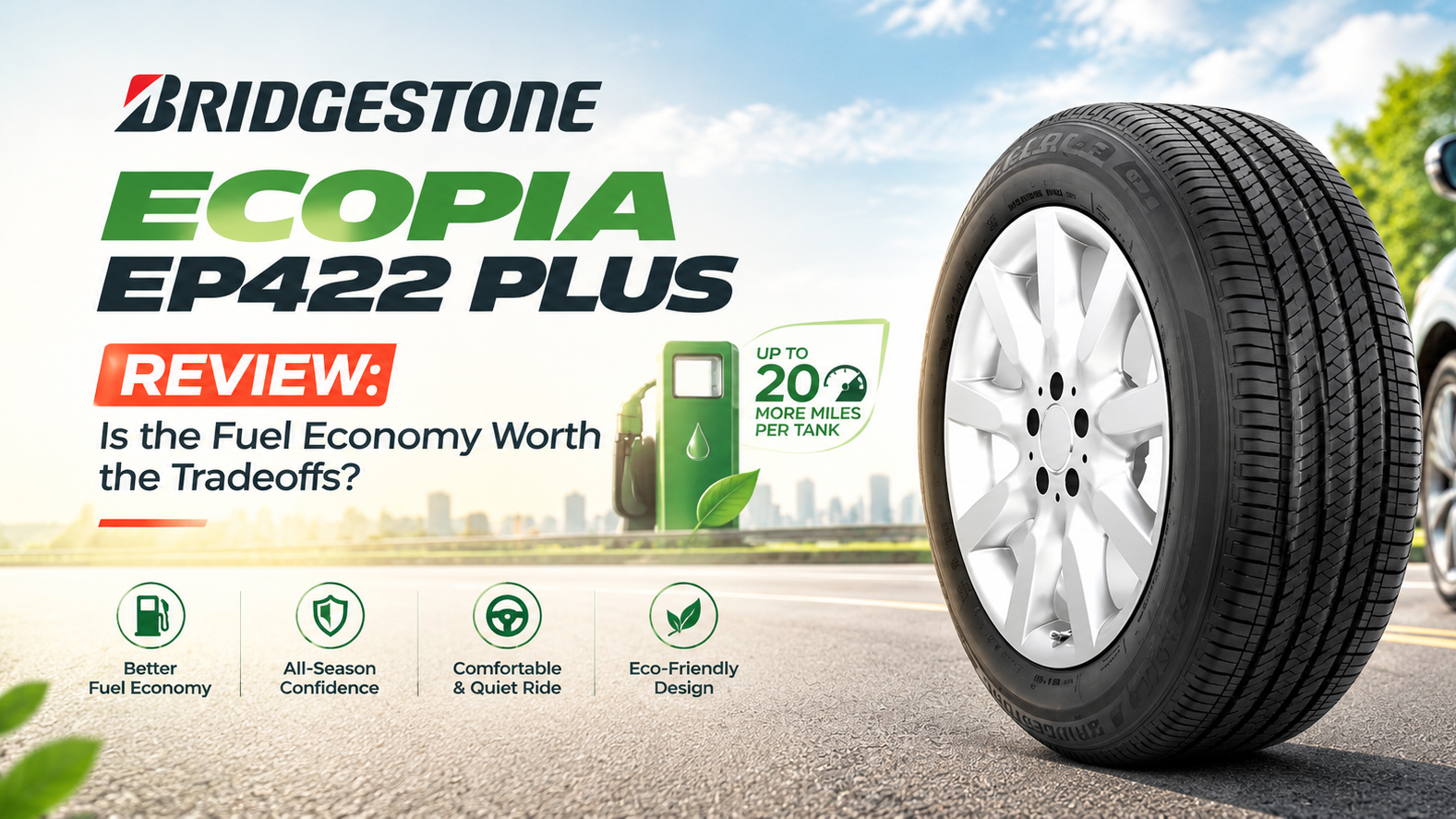
Bridgestone built the Ecopia EP422 Plus around a single promise: an extra 20 miles per tank compared to older tires in its class. That’s a bold number for a tire company to put on a spec sheet, and the unusual part is that independent lab testing and real owner data mostly back it up.
The rest of the story is more complicated. This Bridgestone Ecopia EP422 Plus review walks through where that fuel-saving design pays off, where it costs you something in return, and whether the tradeoff makes sense for the car you actually drive.
What Kind of Tire Is the Ecopia EP422 Plus?
This is a standard touring all-season tire, not a performance or winter model, built for sedans, minivans, and small crossovers that spend most of their life on smooth highways. It fits a wide range of everyday vehicles, from the Honda Civic to the Chrysler Pacifica.
| Spec | Detail |
|---|---|
| Tire type | Standard Touring All-Season |
| Season | All-season, M+S rated, not 3PMSF certified |
| UTQG rating | 540 AA to 640 AA, depending on size |
| Speed rating | T, H, or V, depending on size |
| Rim sizes | 15 to 18 inches |
| Common sizes | 205/60R16, 215/55R17, 225/60R17, 215/60R16, 205/65R15 |
| Treadwear warranty | 5 years / 70,000 miles |
| Trial period | 30-day satisfaction guarantee, exchange or refund |
| Construction | Twin steel belts, nylon-wrapped, polyester casing |
| Price range | Roughly $120 to $220 per tire |
| Common fit vehicles | Honda Civic, Hyundai Elantra, Toyota Camry, Ford Escape, Chrysler Pacifica, Chevy Cruze, Nissan Sentra, Kia Forte, Buick Enclave |
The Technology Behind the Fuel Savings
Bridgestone’s NanoPro-Tech compound is the core of this tire’s personality. It controls how the rubber polymers and silica filler interact at a molecular level, which cuts the energy the tire wastes as heat while it rolls. Less wasted energy means less drag on your engine or battery.
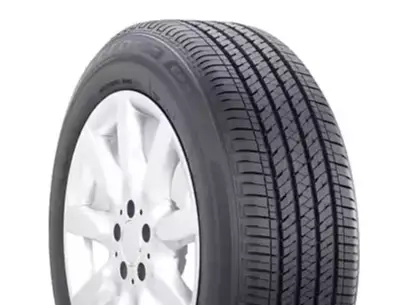
The Fuel Saver Sidewall works on the same problem from a different angle. It reduces heat buildup and energy loss as the sidewall flexes, which is where a surprising amount of rolling resistance comes from on a normal tire.
The tread uses a symmetric pattern with independent center blocks and notched shoulders, aimed at steering response and even wear rather than outright cornering grip. A small detail: roughly 5 percent of the tread rubber is recycled ground rubber. It doesn’t change how the tire drives, but it fits the tire’s eco-minded positioning.
Bridgestone Ecopia EP422 Plus Review: Performance Breakdown
Here’s how each category actually holds up, based on owner reports and independent testing.
Dry Performance
On dry pavement, the EP422 Plus performs with more confidence than its eco-focused reputation suggests. The tread gives solid steering response and a decent on-center feel, and Bridgestone’s claimed 23 percent rolling resistance improvement over the original EP422 also translates into a firmer, more planted feel underfoot on smooth tarmac.
One reviewer testing a Hyundai Elantra noted stable steering and strong braking even under repeated hard stops. Push it into spirited cornering and the softer, comfort-tuned compound produces mild understeer, but for ordinary commuting that’s rarely a real concern.
Wet Performance
This is the tire’s weakest category, and owners are fairly consistent about why. Four circumferential grooves handle routine water evacuation well enough, and lateral grip in the wet, the kind that keeps your car stable mid-corner, is acceptable. The problem is longitudinal traction: wet acceleration and braking trail behind class leaders like the Michelin Defender T+H and Continental TrueContact Tour.
One reviewer who tested the tire directly called the wet braking performance disappointing enough to go shopping for alternatives at replacement time. A Chevy Impala owner said wet traction felt noticeably softer than the performance tire they’d previously run. For light, everyday wet driving it’s fine. For heavy rain or a harder pace, it starts to feel like a limit.
Snow and Ice Performance
Be honest with yourself before buying for this reason alone: the EP422 Plus carries no 3PMSF certification, and it doesn’t pretend to. The tread notches offer moderate help in light, fresh snow, but confidence drops quickly once snow gets packed or roads ice over.
Real-world reports split in a familiar way. One Subaru Forester owner ran these tires through 72,000 miles, including some careful winter driving, with reasonable results. Another driver in the same owner community replaced them at the first real snowfall of the season. Treat this as a three-season tire in practice, whatever the all-season badge on the sidewall claims, and lean on our all-season vs all-weather tires guide if you’re deciding between this and something genuinely winter-capable.
Ride Comfort and Noise
This is where the tire genuinely earns its keep. Bridgestone’s variable pitch tread pattern generates sound-canceling frequencies that cut road noise before it reaches the cabin, and most owners describe the ride as quiet, particularly on the highway. Several Chevy Volt and hybrid owners specifically noted a big drop in road noise compared to their factory tires.
The polyester casing absorbs highway expansion joints and small potholes reasonably well. On rough city streets it’s less impressive, and a handful of owners report noise creeping back in once the tire wears past 14,000 to 20,000 miles, often tied to early cupping rather than the tire’s base design.
Tread Life
Bridgestone backs the EP422 Plus with a 70,000-mile warranty, a genuinely strong figure for this class. Some owners get there and beyond: one Walmart reviewer reported 76,000 miles on a set originally rated for only 60,000, with religious rotation and pressure checks the whole way.
Real-world results are mixed beyond that, though. Several owners report wear indicators flattening out at just 35,000 to 50,000 miles. A Ford Escape owner needed replacement by roughly 31,000 miles, and a Honda driver reported premature wear across two separate sets from the same dealer. The honest takeaway: diligent rotation every 5,000 to 7,500 miles and correct inflation aren’t optional with this tire, they’re the difference between hitting the warranty number and falling well short of it.
Fuel Efficiency
This is the tire’s headline feature, and it holds up under scrutiny better than most marketing claims do. Consumer Reports’ own lab testing rates the EP422 Plus 5 out of 5 for rolling resistance, matching the Firestone All Season at the top of its test group. One Chevy Volt owner saw a 10 percent improvement in electric range right after fitting a fresh set, with further gains once the tires broke in past 2,000 miles.
Several other hybrid and EV owners across forums confirm similar range and fuel economy gains over their previous tires. For high-mileage drivers, those savings compound meaningfully and can offset a real portion of the tire’s purchase price over its lifespan. Our best tires for fuel economy guide compares this against other low-rolling-resistance options.
Value for Money
At $120 to $220 per tire, the EP422 Plus sits mid-pack, and it often undercuts premium rivals. In a 2023 price check on a common 215/60R16 size, it ran about $112, against $142 for the Michelin Defender T+H and $143 for the BFGoodrich Advantage Control. Prices move, so check current numbers for your size. The 30-day trial period also lowers the risk if the tire turns out to be wrong for your car.
For highway-heavy drivers who prioritize fuel savings, the math works clearly in the tire’s favor. For anyone who needs strong wet grip or lives somewhere with real winters, the value case weakens fast, since you’re trading real safety margin for savings that may not even show up if you don’t maintain the tire properly.
What Consumer Reports’ Lab Testing Actually Found
Independent lab data tells a more precise story than owner impressions alone. These scores come from Consumer Reports testing, as summarized in a 2023 comparison, so treat them as a snapshot rather than live numbers. Consumer Reports scored the EP422 Plus 4 out of 5 for dry braking and 3 out of 5 for both wet braking and wet handling, only the BFGoodrich Advantage Control beat it on wet braking in its test field, at 4 out of 5. Hydroplaning resistance scored a strong 4 out of 5.
Winter categories told a similar story: 3 out of 5 for both snow traction and ice braking, behind the Michelin Defender T+H’s 4 out of 5 in snow and the General Altimax RT43’s 4 out of 5 on ice. Tested mileage reached 70,000 miles, solid but short of the 85,000 miles both the Defender T+H and Hankook Kinergy PT achieved in the same test.
The tire’s two standout scores were noise and rolling resistance, both a perfect 5 out of 5, numbers that back up what owners already report anecdotally. This Bridgestone Ecopia EP422 Plus review keeps landing on the same pattern across every data source: genuinely excellent at the two things it was designed for, and solidly mid-pack everywhere else.
Who Should Buy the Ecopia EP422 Plus
The high-mileage highway commuter. Clocking 15,000 to 20,000 miles a year on the motorway means the low rolling resistance shows up in your fuel bills every single month, and the 70,000-mile warranty gives you a real floor on the investment.
The EV or hybrid owner. Lower rolling resistance directly extends range on a charge, and forum data from Chevy Volt and Nissan Leaf owners backs that up with real numbers, not just marketing language.
The budget-conscious family driver in a mild climate. Minivan and midsize sedan owners who want a dependable, reasonably long-lasting tire without sport-tire pricing will find solid value here, as long as winter performance isn’t a real requirement.
If you deal with heavy rain regularly, face real winters, or drive a front-wheel-drive vehicle known for eating through tires fast, the tradeoffs here stack up against you.
Alternatives to the Bridgestone Ecopia EP422 Plus
Michelin Defender T+H (roughly $140 to $250 per tire) is the benchmark in this class for a reason. It delivers meaningfully better wet performance and consistently hits or exceeds its 80,000-mile warranty. It costs $20 to $40 more per tire in most sizes, but the longer tread life often evens out the total cost of ownership across the full lifespan of the set.
Continental TrueContact Tour (roughly $115 to $200 per tire) sits at a similar price point and rates highly for both wet braking and dry handling. You give up a little fuel efficiency compared to the Bridgestone, but gain noticeably more confidence in the rain, a fair trade for drivers in consistently wet regions.
Goodyear Assurance WeatherReady (roughly $130 to $220 per tire) is the pick if you want one tire that covers three seasons including light-to-moderate winter conditions. It carries the 3PMSF certification the EP422 Plus can’t claim. You trade some of the Bridgestone’s fuel-efficiency edge for genuine winter capability. Goodyear has also released a second-generation Assurance WeatherReady 2, so check which version your retailer is quoting.
Weighing it against another Bridgestone touring tire? Our Bridgestone Turanza EL440 review covers the OEM-focused sibling that trades more of its wet and cold-weather grip for low cost. If budget is the deciding factor and you’re open to a different category entirely, our Kumho LX Platinum KU27 review covers a lower-cost touring alternative worth comparing. And if your priorities run the opposite direction toward serious winter capability, our Bridgestone Blizzak LM001 review covers a dedicated winter option from the same manufacturer.
Frequently Asked Questions
How many miles does the Bridgestone Ecopia EP422 Plus last? Bridgestone backs it with a 70,000-mile warranty. Drivers who rotate every 5,000 to 7,500 miles and maintain correct pressure often reach or exceed that figure, with one owner reporting 76,000 miles. Others, especially on front-wheel-drive vehicles or those who skip rotations, report only 35,000 to 50,000 miles before wear indicators appear.
Is the Bridgestone Ecopia EP422 Plus good in rain? It’s acceptable in light to moderate rain, with solid hydroplaning resistance and manageable wet cornering. Wet braking and acceleration traction trail top competitors like the Michelin Defender T+H and Continental TrueContact Tour, so heavy-rainfall regions are better served by a wet-focused tire.
Is the Bridgestone Ecopia EP422 Plus good in snow? Only in very light, fresh snow. It’s not 3PMSF certified and struggles on packed snow or ice. Multiple owners in cold-climate regions describe it as a three-season tire in practice, and dedicated winter tires are the safer call if you face regular snow.
Does the Bridgestone Ecopia EP422 Plus actually save fuel? Yes, this is its best-supported claim. The NanoPro-Tech compound and Fuel Saver Sidewall reduce rolling resistance by roughly 23 percent over the original EP422, and Consumer Reports independently rated it 5 out of 5 for rolling resistance. Real owner data from hybrid and EV forums confirms fuel and range improvements of roughly 5 to 10 percent over standard all-season tires.
What vehicles fit the Bridgestone Ecopia EP422 Plus? It’s designed for coupes, sedans, minivans, and small crossovers, including the Honda Civic, Hyundai Elantra, Toyota Camry, Ford Escape, Nissan Sentra, Chrysler Pacifica, Chevrolet Cruze, Kia Forte, and Buick Enclave, among others, across 15 to 18 inch rim sizes.
Bridgestone Ecopia EP422 Plus Review: Final Verdict
The Bridgestone Ecopia EP422 Plus does exactly what it was built to do. If you’re a highway commuter, an EV or hybrid driver, or someone who wants a quiet, reasonably long-lasting tire for dry roads and mild wet conditions, independent lab data and real owner experience both back this up as a genuinely strong choice.
Where it falls short is wet-weather confidence and anything approaching real winter conditions. Drivers in consistently rainy climates or snow-prone regions will find better options at similar prices, and the inconsistent real-world tread life is worth factoring in before you commit, especially on a front-wheel-drive car.
Buy it if: you’re a highway commuter or hybrid driver in a mild climate who wants genuine fuel savings and a quiet ride. Look elsewhere if: you drive in heavy rain regularly, face real winters, or want a tire that rewards you for pushing harder through corners.