
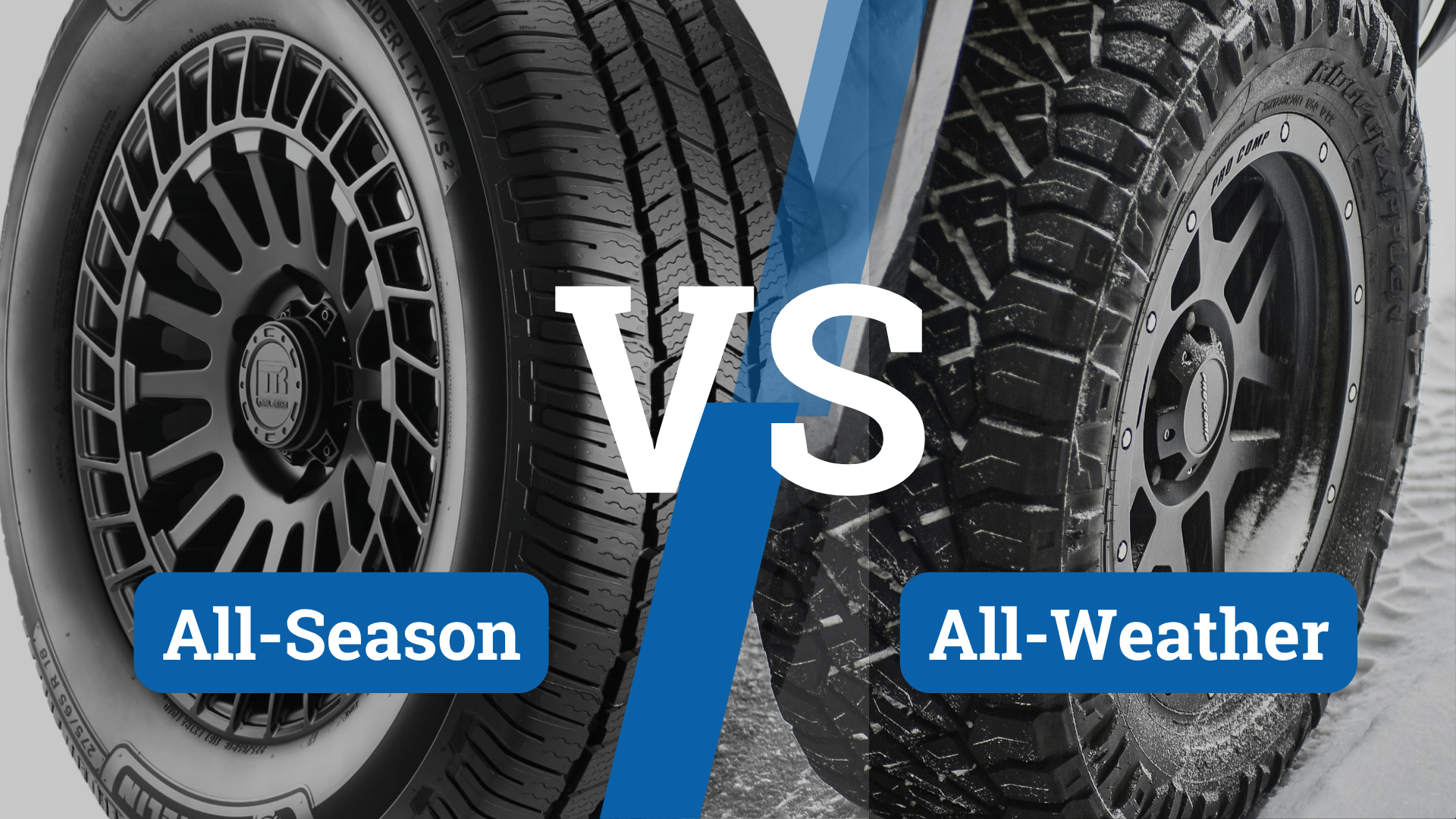
You are standing in a tire shop, or staring at a website, and you see two categories that sound almost identical: all-season and all-weather. The names are barely different. The tires look the same. The prices are close. And yet picking the wrong one could be the difference between stopping safely on a snowy morning and sliding through an intersection.
Here is the short answer before anything else. All-season tires are designed for mild, year-round conditions and lose grip when temperatures drop below 45°F (7°C). All-weather tires are certified for genuine winter use and stay flexible even in freezing cold. One sounds like it does everything. The other actually does.
This guide breaks down exactly what separates them, explains the one certification that matters more than any marketing label, and helps you figure out which tire your driving actually needs.
The Real Difference Between All-Season and All-Weather Tires
Most articles will tell you all-weather tires are better in snow. That is true, but it does not explain why. The actual difference comes down to two things: the rubber compound and a specific certification test. Both of these affect your safety in ways that show up every single winter.
The Rubber Compound
All-season tires are made from a harder rubber compound engineered to perform well in warm and moderate conditions. That hardness gives them good tread life and responsive handling in spring, summer, and fall.
The problem is that hard rubber gets even harder as temperatures drop. Once the thermometer falls below 45°F (7°C), the compound in most all-season tires begins to stiffen. Below freezing, it can become almost board-like, reducing the tire’s ability to flex around road surface irregularities and cutting its grip on cold, wet, or icy pavement.
All-weather tires use a softer, more flexible compound that stays pliable at low temperatures. It does not harden the same way in the cold. That flexibility is what allows the tire to maintain real contact with the road when temperatures fall, and it is the core reason all-weather tires grip better in winter conditions.
The 3PMSF Certification: The Mark That Actually Means Something
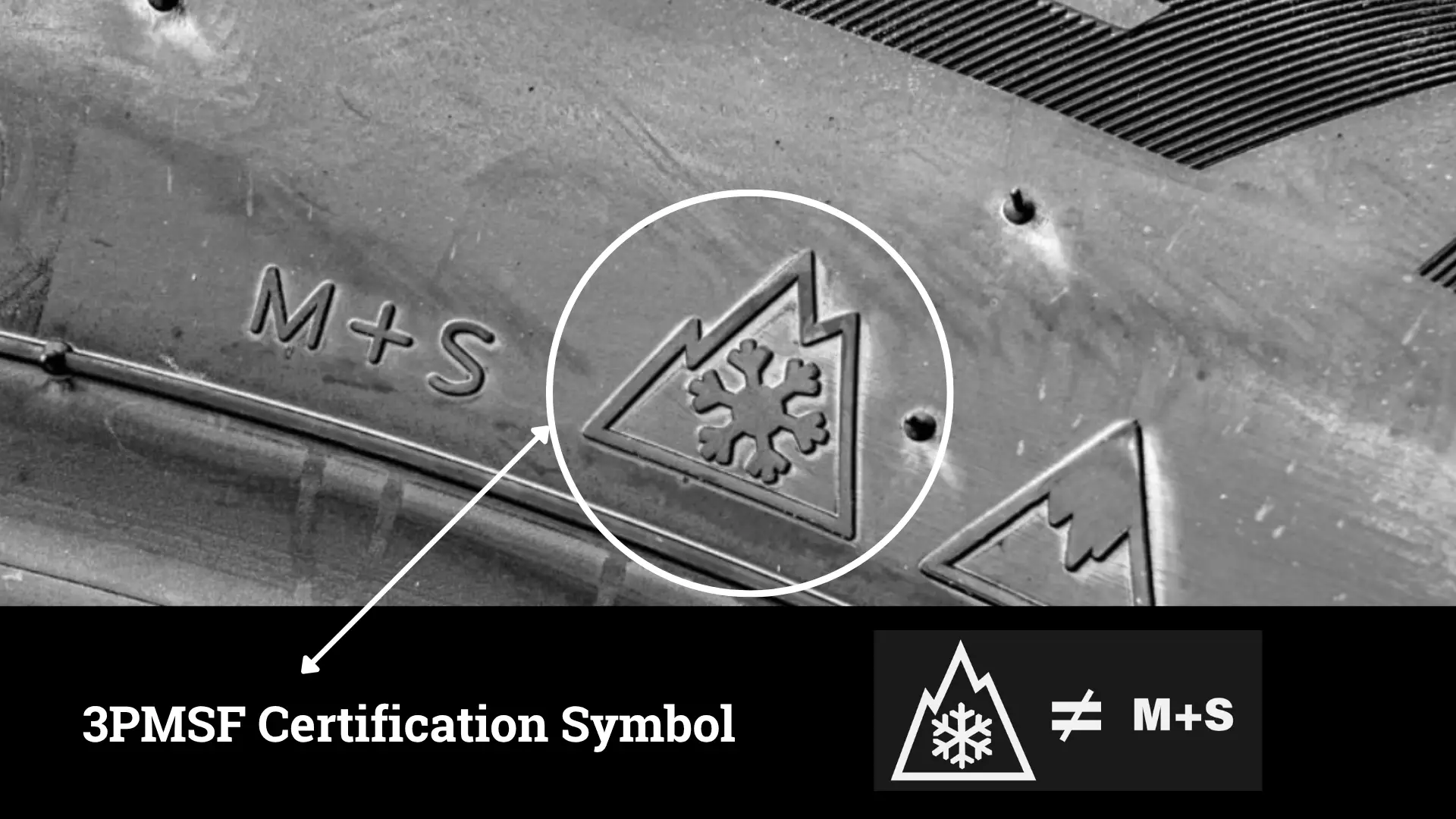
Look at the sidewall of any all-weather tire and you will see a small mountain with three peaks and a snowflake inside it. That is the Three-Peak Mountain Snowflake (3PMSF) symbol, and it is the most important marking on any winter-capable tire.
All-season tires do not carry the 3PMSF symbol. Most carry an M+S (Mud + Snow) rating instead. Here is the catch: M+S is a self-reported marketing designation. Manufacturers apply it to their own products without any standardised performance test. The 3PMSF, by contrast, is a certified rating. It means the tire passed a standardised acceleration test on packed snow and performed at least 10% better than a reference all-season tire. An independent body runs that test. It means something.
This distinction matters beyond just performance. In states like Colorado, traction laws on mountain passes, including stretches of I-70, require tires with the 3PMSF rating during winter conditions. Most all-season tires, even those with M+S markings, do not qualify. An all-weather tire with the 3PMSF symbol does.
All-Season vs All-Weather Tires: Side-by-Side Comparison
| Feature | All-Season Tires | All-Weather Tires |
|---|---|---|
| Rubber compound | Harder, optimised for warm temps | Softer, stays flexible in cold |
| Performance below 45°F / 7°C | Degrades noticeably | Maintains grip well |
| Winter certification | M+S only (self-certified, no test) | 3PMSF certified (independently tested) |
| Snow traction | Light, infrequent snow only | Moderate snow, slush, and light ice |
| Tread pattern | Moderate sipes and grooves | Deeper grooves, more aggressive siping |
| Dry and wet road performance | Excellent | Very good |
| Approximate tread life | 60,000 to 80,000 miles | 50,000 to 65,000 miles |
| Typical price premium | Baseline | Approx. $20 to $50 more per tire |
| Ride noise | Very quiet | Slightly louder in some models |
| Best for | Mild climates, rare light snow | Four-season climates, regular winter weather |
Which Tire Is Right for You? A Climate-Based Decision
The best way to choose between all-season and all-weather tires is to look honestly at where you live and how you drive. Before reading any further, answer these three questions:
- Does your area get snow more than a few times per year?
- Do temperatures regularly fall below 45°F (7°C) in winter?
- Would you ever drive on mountain passes or roads that require winter-certified tires by law?
If you answered no to all three, all-season tires will serve you well. If you answered yes to even one of them, all-weather tires are the smarter investment.
Choose All-Season Tires If You…
- Live in the South, Southwest, or coastal California where snow is rare or nonexistent
- Experience mild winters with some rain, occasional frost, and maybe a light dusting of snow once or twice a year
- Mostly drive in the city and would not drive in serious winter weather even if conditions turned
- Want to maximise tread life and keep the upfront cost per tire as low as possible
Choose All-Weather Tires If You…
- Live in the Midwest, Northeast, Pacific Northwest, or anywhere with real winters
- See temperatures drop below freezing regularly from November through March
- Drive over mountain passes in winter, including routes with 3PMSF traction requirements
- Do not want to deal with seasonal tire swaps but still need meaningful winter capability
- Cannot always avoid driving in snow when it arrives, whether for work, family, or emergency
The one-sentence rule: If you would think twice about going out in a snowstorm on your current tires, you need all-weather tires. If you live somewhere that snow is basically an event rather than a season, all-season tires are fine.
What About Dedicated Winter Tires?
All-weather tires are a genuine step up from all-season in cold conditions, but they are still a compromise. If you live somewhere with sustained, heavy winter conditions, think Minnesota, upstate New York, or mountain towns in Colorado, dedicated winter tires remain the safest choice for those months.
In Tire Rack’s side-by-side winter braking tests, a car on all-season tires needed roughly 30 more feet to stop from 30 mph compared to one running dedicated winter tires. That extra 30 feet is enough space for a serious accident.
All-weather tires fall between those two results. They stop meaningfully shorter than all-season tires in the cold, but not quite as short as a purpose-built winter tire. If you want to see what a proper winter tire delivers, our Bridgestone Blizzak LM001 review covers one of the best ice-focused options available.
The practical question is whether that performance gap justifies buying and storing two separate sets of tires. In truly severe winter climates, the answer is often yes. For most drivers who experience normal four-season winters, all-weather tires are an excellent single-set solution.
The Real Cost Comparison: All-Weather Tires vs Running Two Sets
People often hesitate at all-weather tires because they cost more upfront. When you run the full numbers over several years, the math usually works in their favour.
| Cost Factor | All-Season + Dedicated Winter Set | All-Weather Tires Only |
|---|---|---|
| Initial tire cost (4 tires) | $400 to $600 (all-season) + $600 to $900 (winter) | $500 to $800 |
| Seasonal storage (per year) | $100 to $200 if using a shop | $0 |
| Swap labour fees (per year) | $80 to $150 | $0 |
| Approximate 5-year total | $1,900 to $3,300 | $500 to $800 |
Exact numbers vary depending on your vehicle size, local labour rates, and how many years you keep the tires. But the pattern holds. Unless you genuinely need dedicated winter tires for safety reasons, all-weather tires are the more economical choice over the life of the rubber.
How to Read the Markings on Your Tire Sidewall
You do not need to take anyone’s word for what your current tires can handle. The sidewall tells you everything you need to know.
- M+S or M&S: Mud and Snow. Self-applied by the manufacturer with no standardised snow test required. Most all-season tires carry this. It means the tire is better than a summer tire in mud or light snow, but it is not a winter certification in the true sense.
- 3PMSF (Three-Peak Mountain Snowflake): The mountain symbol with a snowflake inside. Earned by passing an independent, standardised packed-snow acceleration test. Required by traction laws in some US states and Canadian provinces during winter months. All all-weather tires carry this. Most all-season tires do not.
- Studdable: Some tires note they can accept metal studs for extra ice traction. Stud regulations vary by state, so check local law before fitting them.
If you are unsure what is currently on your car, look at the sidewall right now. If you see only M+S with no mountain snowflake, you have all-season tires. If you see the 3PMSF symbol, your tires are winter-certified. It is that simple.
Top All-Season and All-Weather Tires to Consider
Best All-Season Tires
Michelin Defender LTX M/S2: One of the highest-rated all-season tires for trucks, SUVs, and crossovers. Exceptional tread life and outstanding wet-road performance make it a standout pick for drivers in mild climates. Read our full Michelin Defender LTX M/S2 review here.
Michelin Defender LTX M/S (original): The predecessor to the M/S2, still a dependable performer for truck and SUV owners who want proven reliability. See our Michelin Defender LTX M/S review.
Michelin Primacy Tour A/S: A premium all-season touring tire built for sedans, crossovers, and luxury vehicles. Comfortable, quiet, and composed in rain. An excellent pick if ride quality matters as much as grip. Read the full Michelin Primacy Tour A/S review.
Kumho Solus TA51A: A solid, budget-friendly all-season option with a good balance of wet and dry performance for everyday commuters who want reliability without the premium price tag. See our Kumho Solus TA51A review.
Best All-Weather Tires
Goodyear Assurance WeatherReady 2: The benchmark for all-weather tires. A soybean oil compound keeps the rubber pliable in freezing temperatures, and the evolving tread grooves widen as the tire wears to maintain traction over time. Carries 3PMSF certification, offers excellent wet performance, and comes with a 65,000-mile treadwear warranty.
Michelin CrossClimate2: A favourite among automotive reviewers for balancing sharp dry handling with genuine winter capability. The V-formation tread pattern evacuates water efficiently and bites into snow confidently. 3PMSF certified and highly rated for stopping distance in cold conditions.
Continental SecureContact AW: A well-priced all-weather option for passenger cars and crossovers. Reliable braking in snow, good wet-road grip, 3PMSF certified, and a 60,000-mile warranty. A strong pick if you want all-weather performance without the Michelin price tag.
Nokian Tyres Remedy WRG5: Nokian invented the all-weather tire category and their sixth-generation offering shows it. Excellent cold-weather performance with strong wet grip, particularly effective in slush and freezing rain. Worth a look for drivers in northern states.
Frequently Asked Questions: All-season vs all-weather tires
Do all-weather tires wear out faster than all-season tires?
Yes, slightly. The softer compound that makes them better in the cold also wears down a little faster on warm, dry pavement. Most all-weather tires are rated for 50,000 to 65,000 miles compared to 60,000 to 80,000 miles for a typical all-season tire. That is a real trade-off. For most drivers in four-season climates, the winter safety benefit outweighs the modest reduction in tread life.
Can you use all-weather tires in hot summers?
Yes, completely. All-weather tires are designed for year-round use and are safe in summer heat. The softer compound generates slightly more rolling resistance in high temperatures compared to a dedicated summer tire, which can shave a small amount off fuel economy. You will not notice it in daily driving. They are fine in warm weather, just unnecessary if you never see snow.
Are all-weather tires legally required in some areas?
Yes. Several US states and Canadian provinces have seasonal traction requirements, and the 3PMSF symbol is increasingly what those laws reference, not just M+S. Colorado’s traction law on I-70 in the mountains is one well-known example. Quebec and British Columbia both require winter-rated tires during specific months. If you drive in these regions, an all-season tire with only the M+S marking may not legally qualify. An all-weather tire with the 3PMSF symbol will.
Do all-weather tires affect fuel economy?
Slightly. The softer compound and deeper tread of all-weather tires typically produce a bit more rolling resistance than an all-season tire in warm weather, which can reduce fuel economy by around 1 to 3%. In cold weather, the opposite is true. All-season tires harden and create more resistance, while all-weather tires stay flexible and roll more efficiently. Over a full year of four-season driving, the fuel cost difference is minimal for most drivers.
What does the M+S rating on a tire actually mean?
M+S stands for Mud and Snow. It indicates the tire is designed to perform better than a standard summer tire in those conditions. The important caveat: it is a self-certification with no standardised test behind it. Manufacturers apply it to their own products at their own discretion. It is not useless, but it is not a winter certification in the way the 3PMSF symbol is. In regions with traction laws, M+S alone often does not qualify.
Should I get all-weather tires instead of dedicated winter tires?
It depends on the severity of your winters. If you live somewhere with long, harsh winters and regular heavy snowfall for months at a time, dedicated winter tires are still the safest option for those months, paired with all-season tires for the rest of the year. If you experience normal four-season winters with cold temperatures, some snow, and occasional ice, all-weather tires are a practical and cost-effective single-set solution. They will not quite match a dedicated winter tire in deep snow, but they handle real winter conditions far better than any all-season tire.
The Bottom Line on All-Season vs All-Weather Tires
The difference between all-season and all-weather tires comes down to one thing: what happens to the rubber when it gets cold. All-season tires stiffen. All-weather tires stay flexible. That physical difference is why all-weather tires carry the 3PMSF certification and all-season tires do not.
If you are in a warm climate where snow is a once-a-decade event, all-season tires are the right call. Good tread life, great dry and wet performance, no overspending. If you are in a four-season climate where winter means real snow, sub-freezing temperatures, or mountain driving, all-weather tires give you year-round safety without the cost and hassle of running two separate sets.
For more help choosing the right tires for your vehicle, browse our full library of tire reviews and auto guides at AutoTireGuide.com.