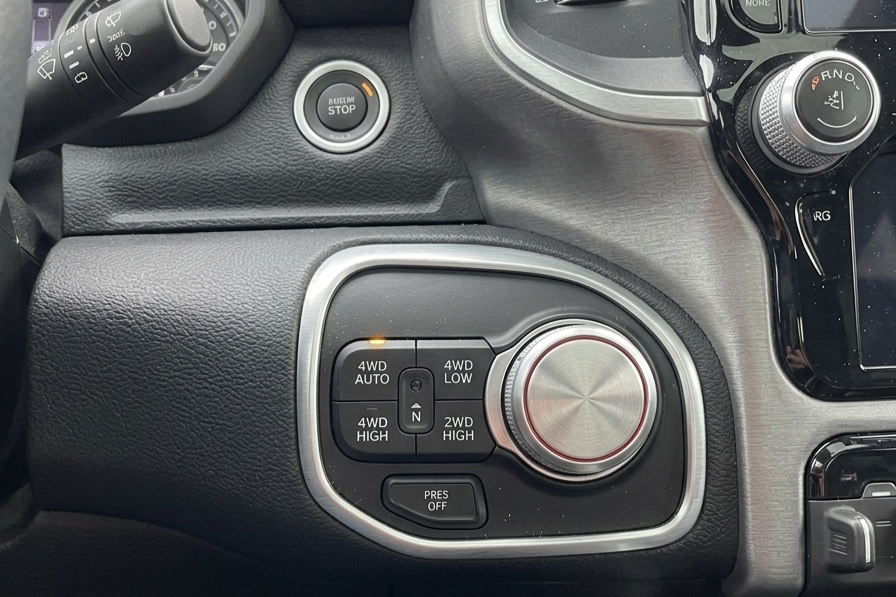
If you just picked up a Ram 1500, Chevy Silverado, or a similar truck and spotted a button or dial labeled 4WD Lock, you are probably wondering what it actually does. 4WD Lock is a transfer case mode that forces the front and rear driveshafts to spin at the exact same speed, giving you a true 50/50 power split between both axles. Using it correctly protects your drivetrain. Using it wrong can cause real damage.
This guide breaks down exactly what 4WD Lock does, how it compares to 4WD High and 4WD Low, and when you should and should not press that button.
What Does 4WD Lock Actually Do?
Your truck normally runs in rear-wheel drive. The rear axle does all the work while the front axle spins freely. When you engage 4WD Lock, the transfer case mechanically joins the front and rear driveshafts together. From that point, both axles receive equal torque simultaneously, regardless of which wheels have grip.
The “lock” in the name refers to that mechanical connection. The front and rear output shafts in your transfer case are locked so they must rotate at the same speed. Even if your rear wheels start spinning on ice or mud, the front wheels are still pulling. That is the whole point.
The simple version: Think of 4WD Lock as telling your truck: “Both ends of this vehicle work together from now on, no exceptions.” That teamwork is exactly what you need on slippery surfaces. It is also exactly what causes problems on dry pavement.
4WD Lock vs. 4WD High: Is There Even a Difference?
On most trucks, the short answer is no. The confusion comes from manufacturers using different names for the same thing. Ram trucks label this mode “4WD Lock.” Most other brands including Ford, Chevy, GMC, Nissan, and Toyota call the identical mode “4WD High” or “4H.”
Both settings lock the transfer case into four-wheel drive at high-range gearing. Both send a 50/50 split of engine power to the front and rear axles. Both are designed for loose or slippery surfaces at normal driving speeds.
If your dial reads 2WD, 4WD Lock, and 4WD Low with no “4WD High” option anywhere, you are not missing a mode. 4WD Lock is your 4WD High equivalent.
The one distinction worth knowing: some newer trucks also offer 4WD Auto. That mode monitors wheel slip and only activates 4WD when the rear wheels start losing traction. It is reactive. 4WD Lock keeps all four wheels committed continuously so you do not wait for the system to catch up to a situation your eyes already saw coming.
4WD Lock vs. 4WD Low: Two Completely Different Tools
This is the comparison that trips up the most owners, and it is worth being precise about because both modes engage all four wheels.
| Feature | 4WD Lock (4WD High) | 4WD Low |
|---|---|---|
| Gearing | Standard high range | Short, low-range gearing |
| Speed | Normal driving speeds | Below 15 mph only |
| Purpose | Traction on slippery surfaces | Maximum torque at low speed |
| Typical use | Snow, mud, sand, loose gravel | Rock crawling, deep mud recovery, steep descents |
| Engage while moving? | Yes, on most modern trucks | No, come to a near stop first |
Here is the practical way to tell them apart: if you are still moving and need to keep moving, that is a 4WD Lock situation. If forward motion has nearly stopped and raw torque is the only thing that will help, that is a 4WD Low situation.
Use 4WD Low for rock crawling at walking pace, winching another vehicle out of deep mud, descending a steep grade without riding your brakes, or dragging a boat trailer out of a ramp that is half submerged and covered in algae. The speed rule for 4WD Low is strict: stay below 15 mph. Exceeding that stresses your transfer case and front axle components hard.
Important: To engage 4WD Low correctly: come to a near stop, shift into neutral, select 4WD Low, then put the truck back into drive. Forcing it while rolling can damage your transfer case.
When Should You Use 4WD Lock?
- Snow and ice on the road. Engage before you reach the slippery stretch, not after you are already spinning. By the time your rear wheels are losing traction, the truck is already fighting itself.
- Mud and loose gravel. A muddy backroad gives your rear wheels an easy path to spin. 4WD Lock keeps the front wheels pulling and prevents the rear-end kick that sends you sideways toward a ditch.
- Deep sand. Beach driving and desert trails require constant momentum. With one axle doing all the work, you dig in. With both axles sharing the load, you float through.
- Unpaved dirt and gravel roads with uneven grip. Ruts, washboards, and soft shoulders all benefit from 4WD Lock even if you are not technically off-roading.
- Heavy rain on dirt or gravel surfaces. Not rain on dry pavement, but rain that has turned an unpaved surface slick. That is fair game.
Rule of thumb: If you would feel nervous driving that same stretch in rear-wheel drive, engage 4WD Lock before you get there. The system works best as prevention, not rescue.
When Should You NOT Use 4WD Lock?
- Dry pavement, full stop. When both driveshafts are locked together on a high-grip surface, your front and rear wheels cannot rotate at slightly different speeds as they need to when cornering. This causes drivetrain binding, also called wind-up. You will feel chirping tires, a shudder through the truck, or jerky steering. Over time it damages your transfer case, U-joints, and CV joints. One short trip on dry asphalt will not wreck your truck, but doing it repeatedly absolutely shortens the life of expensive parts.
- Highway speeds on wet pavement. The road is wet but still has plenty of grip. Engaging 4WD Lock adds stress to the drivetrain without any real traction benefit at speed. Stick with 2WD or 4WD Auto in this situation.
- Firm side slopes where all four wheels have solid contact. Running 4WD Lock here can cause the truck to push sideways because the locked axle speed fights the natural path the wheels want to take. You lose predictability rather than gaining control.
- When you actually need 4WD Low. If you are seriously stuck in deep mud or crawling over rocks, 4WD Lock is not enough. Reaching for 4WD Lock when you should be in 4WD Low is a common mistake and usually just gets you more stuck.
A Note on 4WD Auto
Many trucks sold in the last ten years include a 4WD Auto mode that sits between 2WD and 4WD Lock on the dial. It leaves the front axle partially engaged and activates full 4WD automatically when it detects rear wheel slip.
4WD Auto is practical for variable winter commuting where roads shift between dry pavement, wet pavement, and packed snow within the same drive. It handles those transitions without you touching anything. The trade-off is slightly higher fuel consumption since the front end stays partially engaged even when you do not need it.
Think of it this way: 4WD Auto is for when conditions are unpredictable. 4WD Lock is for when conditions are consistently bad and you want full commitment from the start.
Quick Reference
- 4WD Lock: Same as 4WD High on most trucks. Forces a 50/50 power split between axles at normal driving speeds. Use it on snow, mud, sand, loose gravel, and unpaved surfaces. Never use it on dry pavement.
- 4WD Low: Maximum torque at very low speeds. Reserved for extreme situations: rock crawling, deep mud recovery, steep descents. Stay below 15 mph.
- 4WD Auto: Reactive 4WD that activates on detected wheel slip. Good for unpredictable winter commuting. Less aggressive than 4WD Lock.