Quick Verdict
A technically impressive EV-specific tire that excels on dry roads but leaves some drivers wanting more in the wet. Best for performance EV drivers in warm, dry climates who want better range and sharp handling
The Good
- Outstanding dry grip for EV torque. The ElectricGrip compound handles instantaneous power delivery without squirm or loss of traction, even under hard acceleration.
- Genuine range improvement. Lower rolling resistance compared to standard performance tires translates to measurable additional miles per charge on longer drives.
- Michelin Acoustic Technology works. The foam liner reduces low-frequency resonance inside the cabin, which is a real quality-of-life benefit in the silent interior of an EV.
- Wide size selection. With over 61 sizes covering R19 through R22 wheels, the Pilot Sport EV fits a broad range of modern electric vehicles from both passenger car and SUV/CUV segments.
- Strong dry braking and composure. Stops are short, predictable and stable under hard use. The tire holds its composure when you need it most.
- Purpose-built engineering. The combination of dual compounds, EV-specific carcass construction and Formula E-derived know-how makes this a genuinely thoughtful product rather than a marketing rebrand.
The Bad
- Wet performance is average at best: Independent tests and owner feedback both confirm that the Pilot Sport EV is not a standout performer in heavy rain or standing water. Wet braking and aquaplaning scores lag behind top competitors.
- Ride can be harsh on rough roads: The stiff construction that helps handling on smooth pavement becomes noticeable on broken city roads and concrete highway joints, especially on larger wheel sizes.
- Tread life is modest: 20,000 miles is not a lot for a tire at this price. EV weight and torque accelerate wear faster than the warranty generously allows for.
- Acoustic foam liner can complicate repairs: Some tire shops decline to patch tires with the foam liner, and there are documented cases of the foam separating from the inner surface at higher mileage.
- Premium pricing is hard to justify: At up to $420 per tire, buyers are paying more than competitors who match or beat the Pilot Sport EV in several key categories.
- Summer-only limitation: No cold-weather use means a second set of winter tires is a must-have in colder regions, adding to the total ownership cost.
-
Dry Performance8.5
-
Wet Performance6.5
-
Ride comfort7.0
-
Noise Reduction7.5
-
Tread Life6.5
-
Range and Efficiency8.5
-
Value for Money6.0
If you drive a Tesla Model 3, Model Y, Hyundai Ioniq 5, Kia EV6, Porsche Macan EV or any other performance electric vehicle, you already know that your car eats tires differently than a regular car. The instant torque hits hard. The battery weight pushes down harder. And the dead silence inside the cabin means every road noise is front and center.
The Michelin Pilot Sport EV was built to fix all of that. It is Michelin’s first tire designed from the ground up specifically for electric vehicles and it draws on the brand’s experience in Formula E racing. The idea is simple: give EV drivers maximum grip, lower rolling resistance for better range and a quieter cabin experience all in one package.
So does it deliver? Mostly yes. But there are some real-world trade-offs that the marketing material does not shout about. This Michelin Pilot Sport EV review digs into all of it, including honest owner feedback from forums, buyer reviews and independent test data.
Michelin Pilot Sport EV: Key Specs at a Glance
| Spec | Details |
|---|---|
| Tire Type | Max Performance Summer |
| Season | Summer only (not rated for snow or ice) |
| Size Range | 235/35 R19 to 315/35 R22 (61+ sizes) |
| Rim Diameter | R19 to R22 |
| UTQG Rating | 320 AA A |
| Treadwear Warranty | 20,000 miles / 6 years (half mileage for staggered fitments) |
| Workmanship Warranty | 6 years / Free replacement first year, then prorated |
| EU Wet Grip Label | B |
| EU Energy Efficiency Label | B |
| Price Per Tire | ~$180 to $420 |
| Vehicle Fitment | Tesla Model 3, Tesla Model Y, Porsche Macan EV, Hyundai Ioniq 5, Kia EV6, Ford Mustang Mach-E, BMW iX, Audi e-tron, and others |
| Notable Technology | ElectricGrip compound, GreenPower shoulder compound, Michelin Acoustic foam liner, MaxTouch Construction, Greenbelt internal construction |
| Launch Year | 2020 |
Note: The mileage warranty is halved for staggered fitments where front and rear tires are different sizes. Always confirm sizing compatibility with your specific vehicle before purchasing.
Michelin Pilot Sport EV Tire Technology and Construction Explained
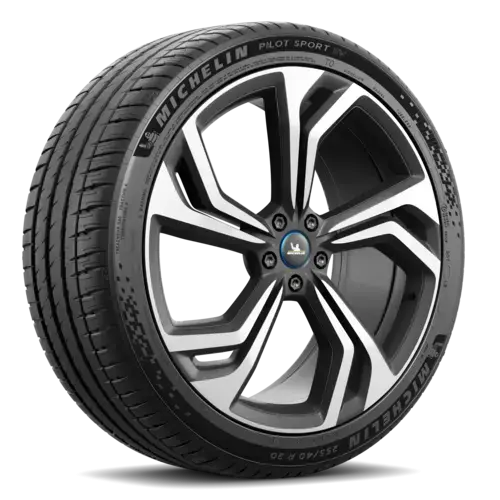
The compound story is what makes this tire different from anything else on the market. The center of the tread uses the high stiffness ElectricGrip compound, developed for maximum grip specifically around EV torque transmission. This draws directly from Michelin’s Formula E racing programme, where controlling instant, violent torque delivery is a core engineering challenge. The shoulders use the high efficiency GreenPower compound, designed to reduce energy consumption and increase range. Two different rubber formulas in one tire, each doing a specific job.
The internal construction is built around the demands of heavy electric vehicles. Two Greenbelt steel top belts are designed to improve rolling resistance, supported by a reinforced polyester sidewall and a polyamide cap ply for handling stability at high speed. On top of that, MaxTouch Construction maximises the contact patch and evenly distributes the forces of braking, acceleration and cornering for extended tread life. This matters because EVs hammer a single patch of tire far harder than combustion vehicles do.
The final layer is acoustic. Michelin’s Acoustic Technology uses a custom designed polyurethane foam liner bonded to the inside of the tire to muffle noise resonance, reducing driver fatigue on long drives. In a silent EV cabin, road noise that a petrol car would mask becomes immediately noticeable. The foam liner is Michelin’s direct answer to that problem. It also explains why some repair shops hesitate to patch these tires, something worth knowing before you buy.
Michelin Pilot Sport EV Performance Breakdown
This is where it matters most. Let’s go through every performance category based on what real drivers, independent tests and owner reviews have reported.
Dry Performance
On dry pavement, the Michelin Pilot Sport EV feels right at home. The ElectricGrip compound in the center of the tread is specifically formulated to handle the kind of instant, heavy torque that EVs deliver the moment you press the accelerator. Braking distances are short and very predictable with the tire staying composed under hard stops which matters a lot when you have a 4,500-pound electric crossover that needs to slow down fast.
Cornering is precise with a stiff outer shoulder that provides clear feedback through the steering wheel. Michelin’s own internal testing shows the Pilot Sport EV delivers 15% higher cornering stiffness compared to the Pilot Sport 4 SUV. That translates into sharper lane changes and a more connected feel on winding roads.
Drivers of the Porsche Macan EV and Tesla Model Y consistently praise how planted the tire feels during spirited dry-road driving. For everyday commuting and performance-oriented use on dry surfaces, this tire delivers what it promises.
Wet Performance
This is the most debated part of the Michelin Pilot Sport EV and it is worth being honest here. The tire is adequate in light to moderate rain but it is not exceptional. Multiple independent comparison tests place the Pilot Sport EV in the lower half of the field for wet braking and aquaplaning resistance.
Wide circumferential channels and lateral grooves are designed to push water out from under the contact patch and they do a decent job in moderate rain. But when the downpours get heavy or the road surface holds standing water, a number of owners report that confidence drops noticeably. Forum discussions on MacanEVowners and Tesla Motors Club include drivers who switched away from the Pilot Sport EV specifically because of wet-weather nerves.
Michelin rates the tire B on the EU wet grip scale which is honest. It is not bad but it is not class-leading either. If you live somewhere with frequent heavy rain or poorly drained highways, this is the single most important factor to weigh before buying.
Snow and Ice Performance
Do not use this tire in snow or ice. The Pilot Sport EV is a summer-only tire. It does not carry the Three-Peak Mountain Snowflake (3PMSF) rating and Michelin explicitly states it is not designed for cold-weather use. Using it below roughly 45 degrees Fahrenheit (7 degrees Celsius) causes the compound to harden, dramatically reducing grip and creating a genuine safety risk.
If you live somewhere with cold winters, a dedicated set of winter tires is non-negotiable. No exceptions.
Ride Comfort and Noise
The story here is split and it depends heavily on your vehicle and wheel size. Michelin’s Acoustic Technology uses a custom polyurethane foam liner bonded to the inside of the tire, designed to reduce in-cabin resonance noise by up to 20%. In controlled testing, this does reduce the low-frequency hum that EVs amplify. Many owners notice a genuine improvement in cabin quietness compared to standard performance tires.
However, the ride stiffness is a separate issue. Owners on the Porsche Macan EV forum who switched from the Pilot Sport EV to the Michelin Pilot Sport All Season 4 described the difference as night and day. The Pilot Sport EV’s construction is firm especially on 21-inch and 22-inch wheel fitments. On rough pavement, broken surfaces or expansion joints, you will feel the road.
A handful of owners also flagged a specific cavity resonance noise around 200Hz that they found irritating on anything but smooth asphalt. Verdict: comfortable on smooth highways, noticeably firm on bad roads.
Tread Life
With a UTQG treadwear rating of 320, the Pilot Sport EV lands in average territory for a max-performance summer tire. The MaxTouch Construction is designed to distribute the forces of acceleration, braking and cornering more evenly across the contact patch, which helps slow down wear. The warranty covers 20,000 miles which is modest for a premium-priced tire.
Real-world results vary widely. Some owners of lighter vehicles with gentle driving habits report strong wear past 30,000 miles on rear fitments. Others on heavier crossovers with spirited driving habits see wear indicators well before the warranty mark. There are also documented cases of the acoustic foam liner separating from the inner surface at higher mileage, causing highway vibration.
Rotation is critical. If your EV uses a staggered fitment, you cannot rotate traditionally. Factor that into long-term cost planning before purchasing.
Fuel Efficiency
This is a genuine highlight. The GreenPower shoulder compound and Greenbelt internal construction work together to produce significantly lower rolling resistance than conventional performance tires. Michelin’s own data shows a rolling resistance of 6.7 kg/t for the Pilot Sport EV versus 8.8 kg/t for the Pilot Sport 4 SUV.
On a typical high-performance EV with a 540 km range, that gap translates to over 60 additional kilometres per charge or more than 10% extra range. In practice, most owners do not report dramatic gains because driving style has a bigger impact than tire choice. But for those who monitor efficiency closely, the Pilot Sport EV does hold a clear edge over non-EV-optimised performance tires.
Value for Money
At $300 to $420 per tire for popular sizes, the Michelin Pilot Sport EV sits at the premium end of the market. That pricing is harder to justify when you weigh the modest tread life warranty, the average wet-weather performance and the availability of strong alternatives at lower prices.
The Hankook iON Evo has outperformed the Pilot Sport EV in at least one independent EV tire comparison, at a lower price. The Pirelli P Zero E also delivers comparable or better wet grip in several markets at a reduced cost. The Michelin brand, acoustic technology and dry-road pedigree do command a premium. Whether that premium is worth it depends entirely on your priorities.
Who Should Buy the Michelin Pilot Sport EV?
1. The Performance EV Driver in a Warm Climate
If you drive a Tesla Model Y Performance, Hyundai Ioniq 5 N, Kia EV6 GT or similar in a place like Southern California, Texas, Florida or the American Southwest, this tire is genuinely excellent. The dry grip is confidence-inspiring, the range benefit is real and the cabin noise improvement makes long highway trips noticeably more pleasant. This is the driver the Pilot Sport EV was built for.
2. The Brand-Conscious Buyer Who Wants OEM Quality
Many electric vehicles come from the factory on the Pilot Sport EV. If you want to replace your worn original tires with something that matches the driving character your vehicle was engineered around, this is the safe and sensible choice. You already know what the tire feels like on your car which removes a lot of the guesswork.
3. The Range-Focused Daily Driver
If maximising range is your top priority and you mostly drive in favourable weather, the Pilot Sport EV’s low rolling resistance makes a tangible difference. You will notice it most on longer highway trips where rolling resistance compounds over distance. For efficiency-minded EV owners who still want performance feel, this tire hits the right balance.
Alternatives to the Michelin Pilot Sport EV
1. Pirelli P Zero E (~$150 to $350 per tire)
The Pirelli P Zero E is the most direct competitor and is frequently cited as offering stronger wet-weather performance and shorter wet braking distances than the Pilot Sport EV while coming in at a lower price point in many markets. Dry performance is comparable though the Michelin has a slight edge in cornering stiffness. If wet grip is a priority for you, the P Zero E is worth serious consideration before deciding.
2. Hankook iON Evo (~$130 to $280 per tire)
The Hankook iON Evo has turned heads in independent comparison tests by outperforming more expensive competitors in several key dry and wet categories. It offers very low rolling resistance, solid comfort and competitive pricing. It does not carry the same brand prestige as Michelin, but the performance data is hard to argue with. A strong choice for budget-conscious EV drivers who do not want to compromise too much on grip.
3. Michelin Pilot Sport All Season 4 (~$150 to $300 per tire)
If you want Michelin quality but need year-round versatility and a more comfortable ride, the Pilot Sport All Season 4 is the natural alternative within the same family. Multiple owners who switched from the Pilot Sport EV to the All Season 4 report a dramatically more comfortable and quieter ride with minimal impact on efficiency. You give up some peak summer dry performance but gain genuine cold-weather capability and a noticeably smoother ride on imperfect roads.
Michelin Pilot Sport EV: Final Rating and Verdict
The Michelin Pilot Sport EV is a well-engineered, purpose-built tire that does several important things very well. The dry grip is confidence-inspiring, the range benefit is measurable and the acoustic technology genuinely improves life inside a quiet EV cabin. For the right driver in the right climate, it is a strong recommendation.
But it is not without real weaknesses. Wet-weather performance is the most important limitation to understand before you buy. If you live somewhere that sees regular heavy rainfall, there are better-suited options. The firm ride and modest tread life also mean the premium price is not always easy to justify against newer competitors at lower prices.
Buy it if: you drive a performance EV in a warm, dry climate and want the best dry grip combined with improved range. Look elsewhere if: you drive in heavy rain regularly, want long tread life or prefer a softer and more forgiving ride.
Frequently Asked Questions: Michelin Pilot Sport EV
Is the Michelin Pilot Sport EV good in the rain?
It is adequate in light to moderate rain but it is not exceptional in wet conditions. Multiple independent tests and owner reviews note that wet braking and aquaplaning resistance fall below the top competitors in its class. Michelin rates it B on the EU wet grip scale which is acceptable but not best-in-class. If you drive frequently in heavy rain, the Pirelli P Zero E is a stronger alternative to consider.
How many miles does the Michelin Pilot Sport EV last?
Michelin covers the tire for 20,000 miles over 6 years with half mileage credit for staggered fitments. Real-world life varies significantly. Light drivers on smaller, lighter EVs can get 30,000 miles or more from rear tires. Heavier crossover drivers with frequent hard acceleration may see wear before 20,000 miles. Consistent rotation (where possible), proper inflation and annual alignment checks will extend life noticeably.
Can I use the Michelin Pilot Sport EV in winter or snow?
No. The Pilot Sport EV is a summer-only tire. It does not carry the Three-Peak Mountain Snowflake (3PMSF) rating and should not be used below approximately 45 degrees Fahrenheit (7 degrees Celsius). The compound hardens in cold weather, dramatically reducing grip and creating a safety risk. A dedicated set of winter tires is required if you live in a cold-weather region.
Does the Michelin Pilot Sport EV actually improve range?
Yes, measurably. Michelin’s data shows the Pilot Sport EV has a rolling resistance of 6.7 kg/t versus 8.8 kg/t for the Pilot Sport 4 SUV. On a typical high-performance EV with a 540 km range that gap adds over 60 km of extra range or more than 10% of initial range. In everyday driving, most owners notice a modest but real improvement in efficiency, especially on longer highway trips.
Is the foam liner a problem for tire repairs?
It can be. The Michelin Acoustic Technology foam liner bonded to the inside of the tire works well for noise reduction but some tire repair shops decline to patch or plug tires with this foam because the liner complicates access to the inner surface. Before buying, confirm that your local tire shop is comfortable working with foamed tires. In some documented owner cases, the foam has also separated from the inner surface at higher mileage causing vibration at speed.
What cars does the Michelin Pilot Sport EV fit?
The Pilot Sport EV is available in over 61 sizes spanning 19 to 22-inch wheel diameters. Common fitments include the Tesla Model 3, Tesla Model Y, Porsche Macan EV, Hyundai Ioniq 5, Kia EV6, Ford Mustang Mach-E, BMW iX and Audi e-tron. It is designed for both passenger car and CUV/SUV electric vehicles, covering Battery Electric Vehicles (BEV) and Plug-In Hybrid Electric Vehicles (PHEV).