
You spot a number like 97V stamped on your tire sidewall and wonder what it actually means. The 97 is the load index: a code that tells you the maximum weight that tire can safely carry. That single number matters more than most drivers realize, and most explanations online do not go far enough to be genuinely useful.
This guide covers exactly what the load index on a tire means, how to read it, how to calculate the total weight your four tires can actually support, what happens when you get it wrong, and a section nearly every other article skips entirely: what the rise of electric vehicles means for load index requirements.
What Is a Load Index on a Tire?
What is a load index on a tire? It is a standardized number, typically ranging from 70 to 126 for passenger vehicles, that corresponds to the maximum weight a single tire can safely support when inflated to its maximum recommended pressure.
It is not the actual weight in pounds or kilograms. It is a code. Index 97 means 1,609 lbs. Index 105 means 2,039 lbs. You need a load index chart to translate the number into a real weight, which is why the full chart is included below.
The load index appears on the sidewall of every tire, directly after the tire’s size designation. In a tire marked 225/55R17 97V, the 97 is the load index and the V is the speed rating. Always two separate pieces of information, always printed side by side.
How to Read the Load Index on Your Sidewall
Look at the sidewall of any tire: the flat outer wall between the tread and the wheel. You will see a long string of characters describing the tire’s size, type and ratings. Here is what they each mean:
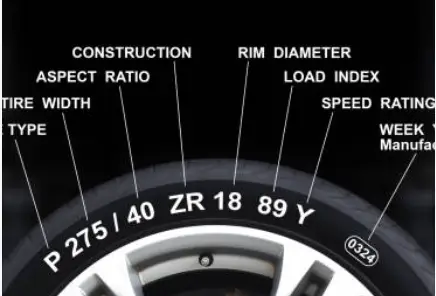
P225/55R17 97V
P — Passenger tire (LT = light truck, no letter = European metric)
225 — Tread width in millimeters
55 — Aspect ratio: sidewall height as a percentage of tread width
R — Radial construction
17 — Wheel diameter in inches
97 — Load index
V — Speed rating
If you need to know what load index your vehicle requires, the fastest source is the sticker on the inside of the driver’s door jamb. It lists the original equipment tire size, which includes the correct load index. Your owner’s manual will also specify it under tire specifications.
Tire Load Index Chart (70 to 126)
Use this table to convert any load index number into the actual weight capacity it represents per tire. Common passenger vehicle load indices are highlighted.
| Load Index | Max Load per Tire (lbs) | Max Load per Tire (kg) |
|---|---|---|
| 70 | 739 | 335 |
| 71 | 761 | 345 |
| 72 | 783 | 355 |
| 73 | 805 | 365 |
| 74 | 827 | 375 |
| 75 | 852 | 387 |
| 76 | 882 | 400 |
| 77 | 908 | 412 |
| 78 | 937 | 425 |
| 79 | 963 | 437 |
| 80 | 992 | 450 |
| 81 | 1,019 | 462 |
| 82 | 1,047 | 475 |
| 83 | 1,074 | 487 |
| 84 | 1,102 | 500 |
| 85 | 1,135 | 515 |
| 86 | 1,168 | 530 |
| 87 | 1,201 | 545 |
| 88 | 1,235 | 560 |
| 89 | 1,279 | 580 |
| 90 | 1,323 | 600 |
| 91 | 1,356 | 615 |
| 92 | 1,389 | 630 |
| 93 | 1,433 | 650 |
| 94 | 1,477 | 670 |
| 95 | 1,521 | 690 |
| 96 | 1,565 | 710 |
| 97 | 1,609 | 730 |
| 98 | 1,653 | 750 |
| 99 | 1,709 | 775 |
| 100 | 1,764 | 800 |
| 101 | 1,819 | 825 |
| 102 | 1,874 | 850 |
| 103 | 1,929 | 875 |
| 104 | 1,984 | 900 |
| 105 | 2,039 | 925 |
| 106 | 2,094 | 950 |
| 107 | 2,149 | 975 |
| 108 | 2,205 | 1,000 |
| 109 | 2,271 | 1,030 |
| 110 | 2,337 | 1,060 |
| 111 | 2,403 | 1,090 |
| 112 | 2,469 | 1,120 |
| 113 | 2,535 | 1,150 |
| 114 | 2,601 | 1,180 |
| 115 | 2,679 | 1,215 |
| 116 | 2,756 | 1,250 |
| 117 | 2,833 | 1,285 |
| 118 | 2,910 | 1,320 |
| 119 | 2,998 | 1,360 |
| 120 | 3,086 | 1,400 |
| 121 | 3,197 | 1,450 |
| 122 | 3,307 | 1,500 |
| 123 | 3,417 | 1,550 |
| 124 | 3,527 | 1,600 |
| 125 | 3,638 | 1,650 |
| 126 | 3,748 | 1,700 |
Highlighted rows (90 to 105) represent the range most common on everyday passenger cars, sedans, and crossovers.
How to Calculate Your Vehicle’s Total Load Capacity
Here is the practical calculation most guides skip entirely. Take the load per tire, multiply by four, and compare it against your vehicle’s Gross Vehicle Weight Rating (GVWR).
Example: your tires carry a load index of 97, which equals 1,609 lbs per tire.
1,609 × 4 = 6,436 lbs total tire capacity.
Now locate your vehicle’s GVWR on the door jamb sticker. The GVWR is the maximum your vehicle should weigh when fully loaded: passengers, cargo, fuel and the vehicle itself combined. If your GVWR is 4,800 lbs, your index-97 tires have a comfortable margin. If your GVWR is 6,200 lbs, that margin is much smaller than you might expect.
Rule of thumb: Your combined tire load capacity should always exceed your vehicle’s GVWR. The larger that margin, the less stress your tires operate under in real conditions.
SL, XL, HL and LT: The Part Most Articles Skip
The load index number alone does not tell the complete story. You also need to understand the load designation printed near the index on the sidewall. This is where most buyers get confused.
Standard Load (SL)
This is the baseline for passenger tires. A Standard Load tire reaches its rated capacity at 35 PSI (36 PSI in some specifications). Most everyday passenger cars use SL tires. If you do not see XL, HL or LT on the sidewall, the tire is almost certainly Standard Load.
Extra Load (XL)
An XL or “Reinforced” marking means the tire has a stronger internal structure and can carry more weight than a Standard Load tire of the same size, but only when inflated to a higher pressure: typically 41 PSI maximum instead of 35 PSI.
Two tires carrying the same load index number, one SL and one XL, will have different actual carrying capacities at full inflation. The XL carries more. XL tires are common on heavier vehicles, performance cars and SUVs where the manufacturer needed more load capacity without increasing tire size.
High Load (HL)
HL is the newest load designation, and it appears on very few tire guides despite being directly relevant in 2026. High Load tires are designed specifically for the increasing weight of electric vehicles and heavy hybrids. An HL tire carries more weight than an XL tire of the same size and pressure, without requiring the driver to move to a larger wheel and tire package.
You will see the prefix HL on the sidewall before the tire size designation. If you drive an electric vehicle or heavy hybrid, check whether your manufacturer specifies HL tires. It is a detail that matters considerably more than most buyers realize.
Light Truck (LT)
LT tires are in a different class entirely. Built with heavier internal construction and higher load capacities for trucks, SUVs and vans used for towing or hauling, they reach their rated capacity at 50 to 80 PSI depending on load range (C, D, E or F).
Important: If your vehicle came with LT tires and you replace them with P-metric (passenger) tires of the same size, you must reduce the usable load capacity by approximately 10 percent to account for the difference in construction. Check your owner’s manual before making this swap.
| Designation | Max Inflation | Best For | Common On |
|---|---|---|---|
| SL (Standard Load) | 35–36 PSI | Everyday passenger vehicles | Sedans, small crossovers |
| XL (Extra Load) | 41 PSI | Heavier passenger and performance vehicles | Large SUVs, performance cars |
| HL (High Load) | 41 PSI | Electric vehicles and heavy hybrids | EVs, long-range hybrids |
| LT (Light Truck) | 50–80 PSI | Towing, hauling, commercial use | Pickup trucks, heavy SUVs |
Load Index and Tire Pressure: The Connection That Changes Everything
This is the single most overlooked fact in almost every article on this topic. The load index rating is only valid at the tire’s maximum inflation pressure. Drop the pressure and you drop the carrying capacity.
A tire rated for 1,609 lbs at 35 PSI is not safely carrying 1,609 lbs when inflated to 28 PSI. The sidewall flexes more, heat builds faster and the risk of failure rises significantly, especially at highway speeds or under heavy load.
This is why proper inflation matters most when you are towing a trailer, loading a truck bed or packing a vehicle to capacity. The number to use for daily driving is the pressure on your door jamb sticker, not the maximum pressure stamped on the tire sidewall. Those are two different numbers that serve two different purposes.
Dual Load Index on LT Tires
If you own a truck or heavy-duty SUV, you may notice a load index printed as two numbers separated by a slash: 121/119R, for example.
The first number (121) is the load capacity when the tire is used as a single: one tire per axle end. The second number (119) is the capacity when used in a dual configuration: two tires mounted side by side on the same axle, which is common on commercial trucks and some heavy-duty pickups.
If you run singles, use the first number. The dual rating is lower because when one tire in a pair fails, the surviving tire must temporarily carry the entire load on that axle end.
Load Index and Electric Vehicles: What Most Guides Do Not Cover
Electric vehicles present a load index challenge that is not yet widely understood. Most EVs are significantly heavier than comparable gasoline vehicles, often by 400 to 800 lbs, because of the battery pack. A Tesla Model Y weighs roughly 4,400 lbs. A Honda CR-V of similar dimensions weighs around 3,300 lbs. That difference lands entirely on the tires.
Standard passenger tire load ratings, including the XL designation that was previously considered adequate for heavy vehicles, are being stretched by current EV weights. This is why the HL (High Load) category was introduced: to provide higher carrying capacity within the same tire size, without requiring owners to fit larger wheels.
If you drive an electric vehicle, the load index on your tires is not a technicality. It is a primary safety specification. EVs also generate instant torque, which places sudden and significant stress on the tire’s contact patch and sidewall in ways that gradually wear tires rated at the margin of their capacity. Always verify that your replacement tires meet or exceed the load index your EV manufacturer specifies, and check whether your model calls for XL or HL designation specifically.
What Happens If the Load Index Is Too Low
Using a tire with a lower load index than your vehicle requires is a safety risk. Here is what actually happens over time:
- Heat buildup: An overloaded tire generates excessive heat from sidewall flex. Heat is the primary cause of tire structural failure.
- Tread separation: The bond between the tread and the tire carcass can fail under sustained overload, often without warning.
- Blowout: A sudden pressure failure, most often at highway speed, when the tire structure can no longer contain the stress placed on it.
- Reduced braking: An overloaded tire has a distorted contact patch with the road. Grip is reduced and stopping distances increase.
- Accelerated wear: The tire wears unevenly and far more quickly than its tread life rating would suggest.
The damage rarely happens immediately. A tire slightly under the required load index may perform without obvious problems for months on an empty vehicle. The failure arrives on a hot day, at highway speed, with five passengers and a loaded trunk: exactly the moment you need every component to perform correctly.
Can You Go Higher Than the Required Load Index?
Yes, and doing so is safe. If your vehicle requires a load index of 97 and you install tires rated at 99 or 101, those tires can carry more weight and will not cause problems.
One nuance worth knowing: if you move significantly higher by switching to an XL or LT tire when the manufacturer specified a Standard Load passenger tire, you may need to adjust inflation pressure. A higher load index tire in a different load class typically requires more air pressure to reach its rated capacity. Running it at the pressure specified for the original SL tire means you are not getting the capacity benefit you paid for.
The rule is simple. Never go lower than the manufacturer’s recommended load index. Meeting or exceeding it is always correct.
Load Index and Towing: What Truck and SUV Owners Need to Know

If you tow a trailer, boat or camper, the load index on your tires becomes considerably more important than it is for everyday driving. Your vehicle’s tires must support not just the vehicle’s own weight but also the tongue weight of whatever is attached to the hitch.
Tongue weight, the downward force the trailer exerts on your hitch ball, is typically 10 to 15 percent of the trailer’s total loaded weight. A 6,000 lb trailer can apply 600 to 900 lbs directly onto your rear axle, transferred entirely through your rear tires. This is why trucks used for serious towing almost always run LT tires with high load ratings rather than standard passenger tires.
Before any towing trip, compare your four tires’ combined load capacity against your vehicle’s Gross Combined Weight Rating (GCWR). The GCWR is the maximum weight of the tow vehicle plus the fully loaded trailer. If your tire capacity does not clearly exceed the GCWR, that is a configuration issue worth resolving before you leave the driveway.
How to Find the Right Load Index for Your Vehicle
You do not need to guess. Three sources give you the exact answer:
- Driver’s door jamb sticker: The fastest source. It lists the OEM tire size and the required load index for your vehicle.
- Owner’s manual: Usually in the tire specifications section toward the back of the manual.
- The tires already on the vehicle: If your current tires are the correct size for your vehicle, the load index printed on their sidewall is your minimum. Do not go below it when purchasing replacements.
When moving from one load range to another, such as from P-metric to LT, confirm the selection with a tire professional. The numbers alone do not capture everything that changes between load classes.
Frequently Asked Questions
What is a load index on a tire, and is it the same as load range?
No. Understanding what is a load index on a tire versus a load range is important, because they measure different things. The load index is a number such as 97 or 105 that corresponds to a specific weight limit per tire. The load range is a letter such as C, D or E that describes the overall construction strength and ply rating of the tire, and is mainly used on LT and commercial tires. Most passenger tires use a load index number only. Heavy-duty tires often show both, and the load range affects what pressure the tire requires to reach its load index rating.
Can I replace my tires with a higher load index?
Yes. Moving to a higher load index is generally safe and adds a useful margin of carrying capacity. The consideration to keep in mind is tire pressure. A higher load index tire, especially in an XL or LT designation, may require different inflation pressures than what your door jamb specifies for the original tire. If you are switching load ranges rather than simply moving the index number up by one or two points, confirm the correct pressure with a tire professional before driving.
What does XL mean on a tire and is it the same as a high load index?
XL, or Extra Load, means the tire has a reinforced internal structure that allows it to carry more weight than a standard load tire of the same size and load index number, but only when inflated to its higher maximum pressure: typically 41 PSI versus 35 PSI for a standard load tire. Two tires both marked with load index 97, one SL and one XL, have different actual weight capacities at full inflation. The XL carries more. Always inflate XL tires to the pressure your door jamb sticker specifies for your vehicle, not simply the maximum pressure printed on the tire itself.
What happens if my tire load index is too low for my vehicle?
Running tires below the vehicle’s required load index creates a risk of heat buildup in the sidewall, structural fatigue, tread separation and blowout, particularly at highway speeds and in hot weather. The risk escalates sharply when the vehicle is fully loaded with passengers and cargo. A slightly under-rated tire may cover hundreds of miles without obvious failure, then give out suddenly when conditions, temperature and load align against it at the worst possible moment.
Do all four tires need the same load index?
Yes. Mixing load indices across four tires creates uneven load distribution and handling imbalances. The tire with the lower rating becomes the weakest point on the vehicle and will wear differently, handle differently under load and may fail before the others. When replacing tires, match all four to the same size, load index and load range. At minimum, keep matching ratings on both tires of the same axle.
The Bottom Line
The load index is a number most drivers walk past without a second glance, but it is one of the most safety-critical specifications on the tire. Get it right and your tires perform exactly as designed for the full span of their rated life. Get it wrong and the failure mode is rarely gradual: it tends to arrive suddenly, under the conditions where reliability matters most.
Match or exceed your manufacturer’s required load index. Understand whether your vehicle calls for SL, XL, HL or LT. Maintain the correct inflation pressure. And if you tow, compare your tire carrying capacity against your GCWR before every trip. Those four habits cover the vast majority of load-related tire problems before they occur.