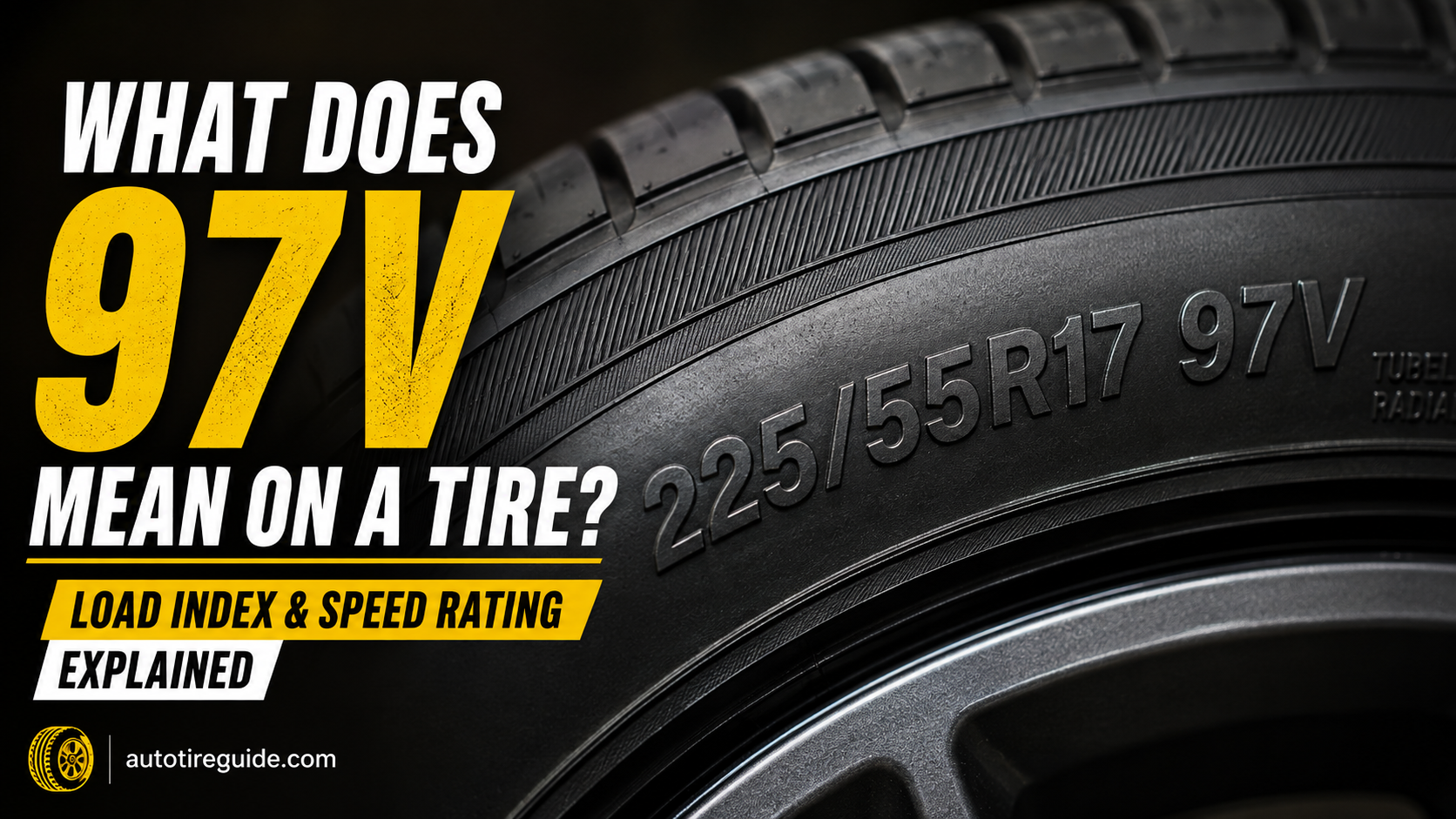
97V on a tire means two things put together. The 97 is the load index, and it tells you the tire can carry 1,609 lbs (730 kg) at full air pressure. The V is the speed rating, and it tells you the tire is built to handle speeds up to 149 mph (240 km/h) for a sustained time. That’s it. Two codes, one job each. Let’s break down where this comes from and what it means for the tires on your own car.
Breaking Down the 97V Tire Code
Look at the side of your tire. You’ll see a long line of numbers and letters, something like 225/55R17 97V. The 97V sits right at the end, after the wheel size. It’s called the service description, and it’s really two separate codes stuck together.
- 97 is the load index. It’s a code, not a weight in pounds. You need a chart to turn it into a real number.
- V is the speed rating. It’s a letter grade that maps to a top speed the tire was tested to handle.
Every tire on your car needs to meet or beat both numbers your vehicle manufacturer calls for. Fall short on either one, and you’re driving on a tire that wasn’t built for your car’s weight or its speed.
What Does the 97 Mean on a 97V Tire?
The 97 is the load index. On the official load index chart, 97 lines up with 1,609 lbs (730 kg) per tire, when the tire is inflated to its max rated pressure. That’s per tire, not for all four combined.
So if your car has four 97-rated tires, the total carrying capacity across the set is roughly 6,436 lbs. To know if that’s enough for your car, check your vehicle’s GVWR (gross vehicle weight rating) on the sticker inside the driver’s door. Your tires’ combined load capacity should always come in higher than that number.
We’ve got a full breakdown of this, including the complete load index chart, in our guide to tire load index.
What Does the V Mean on a 97V Tire?
The V is the speed rating. It’s a letter that tells you the highest speed the tire is rated for over a long stretch of driving, under lab conditions with the tire properly inflated and in good shape. A V rating means 149 mph (240 km/h).
V-rated tires are common on sedans, hatchbacks, and everyday performance cars. You’ll almost never actually hit 149 mph on the road, but the rating still matters. A higher speed rating usually means a stiffer tire construction, which affects how the tire handles heat, cornering grip, and braking, not just top speed.
Where Do You Find 97V on a Tire?
It’s printed on the sidewall, right after the tire size, before the two-word manufacturer info like “extra load” or “reinforced.” On a full tire size, it reads like this: 225/55R17 97V, where 225 is the tread width, 55 is the aspect ratio, R17 is the wheel diameter, and 97V closes it out.
Is a 97V Tire Good for My Car?
97V is good for your car if it matches or beats what your car’s manufacturer calls for. Check your door jamb sticker or owner’s manual for the original tire spec. If it says 97H and you’re looking at 97V, you’re fine, since V handles higher speeds than H while carrying the same load. If it says 100V and you’re eyeing a 97V, the load index is too low, and you’d be under-tired for your car’s weight.
Rule of thumb: never go below the load index or speed rating your car came with. Going above is fine and sometimes even a nice upgrade, especially on the speed rating side. If you want the fuller picture before you buy, our tire buying guide walks through everything else to check beyond just the code on the sidewall.
Common Tire Codes Compared to 97V
Here’s how 97V stacks up against other common codes you’ll see while shopping.
| Tire Code | Load Index | Max Load (lbs / kg) | Speed Rating | Max Speed (mph / km/h) | Typical Use |
|---|---|---|---|---|---|
| 91H | 91 | 1,356 lbs / 615 kg | H | 130 mph / 210 km/h | Compact cars, sedans |
| 94V | 94 | 1,477 lbs / 670 kg | V | 149 mph / 240 km/h | Compact sedans, crossovers |
| 97H | 97 | 1,609 lbs / 730 kg | H | 130 mph / 210 km/h | Mid-size sedans, minivans |
| 97V | 97 | 1,609 lbs / 730 kg | V | 149 mph / 240 km/h | Sedans, hatchbacks, everyday performance cars |
| 97W | 97 | 1,609 lbs / 730 kg | W | 168 mph / 270 km/h | Sport sedans, performance coupes |
| 100V | 100 | 1,764 lbs / 800 kg | V | 149 mph / 240 km/h | Larger sedans, SUVs |
| 101Y | 101 | 1,819 lbs / 825 kg | Y | 186 mph / 300 km/h | High-performance sports cars |
The Bottom Line on 97V
97V on a tire just means it can carry 1,609 lbs per tire and handle sustained speeds up to 149 mph. That’s the whole code. Match it to what your car came with, check the door jamb sticker before you buy, and you’re good to go. That’s all you need to know about what 97V means on a tire.